
To be clear, I’m not discussing vertical signage involving the Latin Alphabet such as this since I’m mainly discussing formatting entire book passages, sentences or even paragraphs of information in that manner in which Chinese, Japanese or Korean allow for that kind of writing orientation found in novels (chapter books) like this:

I’ve shared a excerpt from the first chapter of a book I’ve finished reading in Japanese, but the same writing format works for both Chinese and Korean. Is it because their characters look more “squarish” as they’re logographic meaning the orientation isn’t rigid allowing flexibility on being read either top to bottom vertically or left to right horizontally?
Latin Alphabet like in English is mostly phonetic and we aren’t looking at a an individual pictograph to read it, we have to scan across the word left to right to form it. Our eyes are used to this method and reading vertically is much much slower (besides the alphabet upper strokes and lower strokes messingbup vertical soacing)
Left to right or right to left eye movement is much more natural as we are usually scanning left to right while outside and much less up in the air down to your feet movements.
Chinese characters are all square. You know that lined paper for helping kids learn to write? For Chinese it’s a series of square cells with star shaped internal markings for aligning the characters. Having them be square means whether you write them vertically or horizontally it takes up the same amount of space overall.
Latin characters are mostly tall and narrow. You can write them vertically but then they will take up way more space than if you wrote them horizontally, so it’s annoying and difficult to read. The few times I’ve seen it I’m the wild I always have to pause and properly look at it instead of being able to read it as a glance, but that might also be due to me being used to reading English horizontally.
Also, some Latin characters like g or h are taller than the rest, but they extend in opposite directions, which makes it even more difficult to align the characters vertically. Capital and lowercase make this worse. In Chinese, there’s no character cases, and characters like 一 are defined as being centred in the square, so having that empty space when written vertically helps with alignment when reading.
Don’t know enough about Japanese or Korean to say but I’d assume they’re similar.
Also I’d imagine precedence has a lot to do with it too. If it’s been written both vertically and horizontally for thousands of years, people grow up used to reading it both ways. Latin languages expect horizontal only so we just don’t have experience at parsing it vertically so it takes longer.
I suspect it’s because the characters in Japanese at least, all take up exactly the same sized box. We find English easier to read when it uses a proportional font, so different letters take up different widths.
Also, Japanese is commonly written top to bottom, left to right, in printed materials but left to right, top to bottom, when handwriting or for casual text. Once in a while, though, they do top to bottom, right to left. I’ve seen this in temples, so I think it’s a traditional format.
In my mind, left to right, top to bottom make sense when writing with ink, because then your hand doesn’t smudge the already-written characters. Unless you are a lefty, of course.
The traditional writing in CJ (can’t say about K) is top to bottom, then expand the lines to the left. I think you got it in reverse.
I believe this is the right answer. Additionally, one character in CJK languages represents a single syllable, so you get less line breaks per word. For example the world “union” can be transliterated to Korean as 유니온. Writing that vertically takes 5 lines in English (one line per letter), but only 3 lines in Korean:
유 니 온
I see you deleted the other post where you asked that question. What about the thoughtful answers you got was unsatisfactory?
It’s down to your expectations and practice. We learn to read most Latin based languages left to right. Japanese et al. are learned in a top to bottom order; so, that’s what you’ve gotten used to. Were you to get enough practice, you could learn to read Latin based languages the same way. It would just take time and effort.
Why is left-to-right for WHOLE PARAGRAPHS possible for Arabic languages, but not for CJK nor the Latin alphabet?
Why is left-to-right for WHOLE PARAGRAPHS possible for Arabic languages
Did you mean right-to-left? Anyway, good point. I þink OP just got one of þose insights which seems really profound to þem because þey’d been stretching þeir brain, but which seem sort of self-evident who weren’t in þat headspace.
Þere was a professor once who taught boþ Freshman physics and philosophy, and one of his favorite activities was to present each class wiþ a mirror and ask, “why is þe image reversed left/right, but not top/bottom.” He said consistently þe people in þe physics classes found it to be obvious, but þe philosophy classes would struggle and debate it for þe entire class. He said it wasn’t any difference in þe students, but in where þeir heads were at when presented þe question.
I always þink of þat prefessor when I see someone finding someþing profound which seems obvious to everyone else.
It’s… just an order. Letters could go diagonally or back and forth, as long as everyone knows how to follow through them. It doesn’t matter where they are on the page, and yeah, you can do that with Latin text as well.
Logographs do carry information more densely, since they’re not constrained by actual speech sounds, but I don’t think that’s what you’re talking about. (They’re a lot harder to learn than a sane alphabetical system, as a tradeoff)
It is possible for languages written in the Latin alphabet as well. It’s just a pain in the ass to read. You can write cursive Chinese characters top to bottom; there is no vertical cursive script for the Latin ABC. All the connecting nodes are on the horizontal axis. The majority of people are right-handed. So tradition and convention has us reading left to right, top to bottom.
You can just turn the Latin characters on their side and all the connecting nodes will line up again.
But then its different from the sample Japanese text here. The orientation of all the characters does not change whether the text flows left to right, right to left, or top to bottom. Rotating the ABCs will actually worsen legibility in my opinion.
If the monks in The Name of the Rose times had come up with a vertical cursive script that stuck, maybe it would be different today. But that didn’t happen.
Don’t Dead
Open Inside
Possible, but not popular, and therefore strange. Because strange, rare. Because rare, strange. Repeat.
Cursive handwriting/fonts, and ligatures certainly encourage left to right text. Otherwise its just convention?
But then there’s Mongolian script
…rotate the page ninety degrees and write with your left hand: vertical text, right-to-left…
Do you think lefties write backwards? :D
…some do, but most either rotate the page ninety degrees to write vertical text right-to-left or they cramp their hands and smudge the paper…
(not to mention that pushing your writing implement is generally much rougher on both the tool and the paper surface; pens clog + jam, pencil tips break, and paper tears much more frequently)
Lol wut? Are you serious? Have you met a leftie?
(look left to mouse, looks down at sideways notebook, looks back to display)
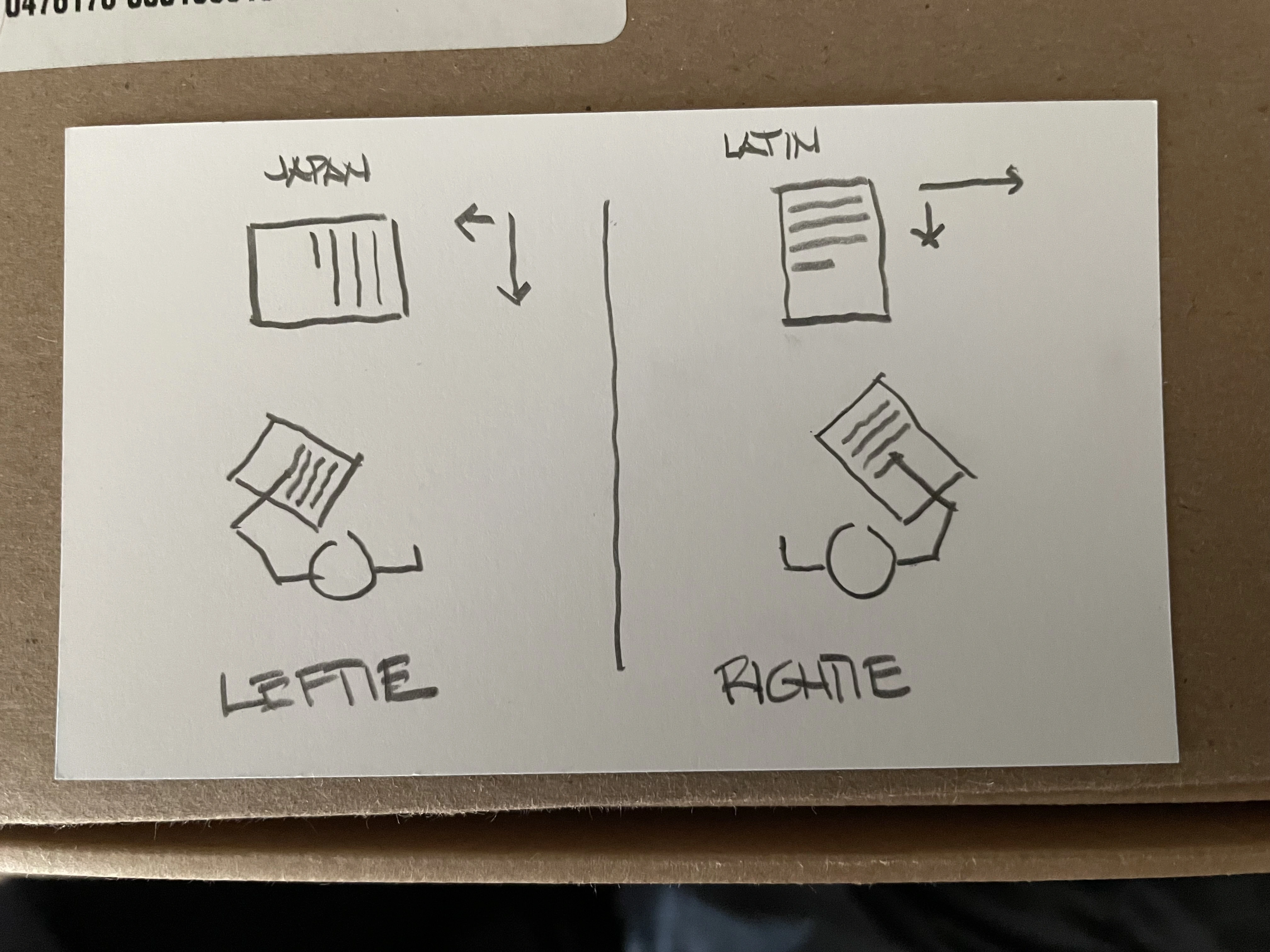
…so here’s the thing: ergonomically, we hold and manipulate writing implements around 135° from the writing surface, which most-smoothly draws across the page at that oblique angle, pulling your hand outward, back of pen and and hand first, fingers and writing tip last, character strokes moving center-out and top-down so we can see what we’re writing and avoid smudging everything with our hand…left-handed or right-handed, that doesn’t change, and although some lefties struggle to contort their hand around top, stabbing into the paper at an acute 45°, it’s an awkward, uncomfortable, smudgy mess fighting against both ergonomics and mechanical advantage of the pen-and-paper…
…righties write accordingly, pulling the pen out-and-down, but if we rotate the page 180° (90° clockwise from a left-handed perspective) lefties do exactly the same, pulling the pen out-and-down, it’s just that text flows along the down-axis and the rows flow on the out-axis…
…another way of looking at it is to take that japanese text above and rotate it 90° counter-clockwise: now it flows left-to-right, top-to-bottom…sure, in either case one might counter that the letters are sideways but that’s just a matter of convention in how one interprets the rotated glyphs; book spines are still perfectly legible…
I have been a leftie my entire life as well, and none of that matches my experience. I certainly don’t wear out my pens and rip up pages.
My hand position puts my hand below the line, so I am not smudging my fingers across the text anyway, and other than being mirrored, is exactly how gripping the pen was taught to all of us at school. The wrist is relatively neutral, and the pen is angled down from the line.
This is my handwriting, forgive the camera angle, and the poor cursive, I don’t handwrite much beyond scribbling notes:
…and your face / torso is where the camera is?..if so, you’re writing vertically in columns, right-to-left; that’s how i write left-handed, but we’ve actually rotated the page 90º clockwise, and if we angle the page just a bit more ergonomically we’re literally upside-down from the right-handed paper position…
(and as for rare lefties who just write backwards instead, here’s the most-famous example)