You must log in or register to comment.
When sailing boats pushed for speed they ended up hitting an unexpected speed barrier. As you increase velocity the break wave created by the bow of the ship elongates until the length of the ship is at 1 wavelength, then the hull drag prevents further acceleration. For a 50 meter ship it’s about 17 knots. You can get much faster lifting the boat from the water as you gain speed with an underwater wing, the current max speed was set 47 years ago at ~276 knots. But that’s only because they can remove the hull from the high drag environment and is extremely dangerous to attempt to break. The speed of light is nothing like that because spacetime itself can stretch and squish, I just wanted to talk about boats for a bit.
Still very interesting
So you’re saying, we need to jump the spaceship out from space/time. With a wing.
I’m not even mad because now I get why and how these competition multihull boats basically fly above water while keeping like 1% of the boat in water
Those ones are reaching a new speed limit as well, the cavitation around the hydrofoil starts at a certain speed/angle and stalls the foil, which then abruptly drops the hull back into the water.
I’ve been wondering how long before the equivalent of variable swept wings will be added to the cup boats.
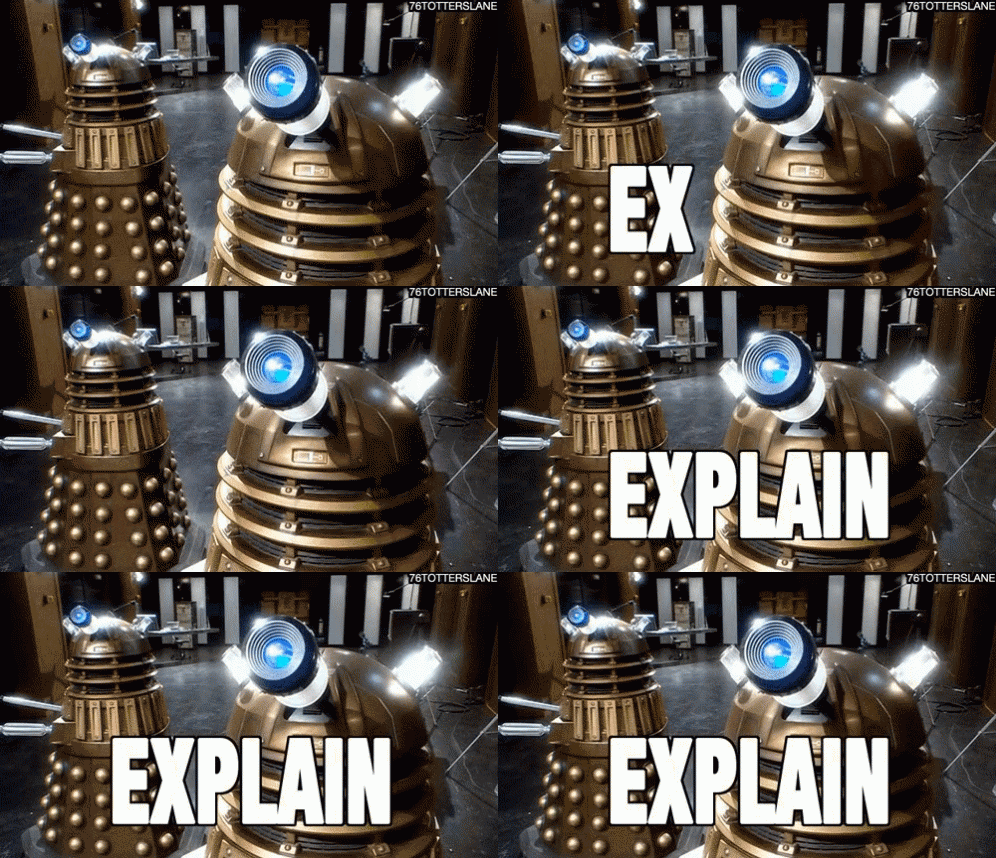
I love this because this feels like something the 10th doctor would say to confused daleks while stalling
I don’t like being deceived John! Tell me more about boats!
You have two observers, moving directly opposite each other.
Each has a flashlight pointing back at the other.
The speed of the light from those torched is the same for both observers.
(Instead the light would be red-shifted.)
Add a third observer, stationary to one and moving towards the other. As the third observer passes that observer, the speed of light from their flashlight never changes, and it’s the same speed as from the other two. (Instead it would go from being blue shifted to red shifted.)
This adds substantially more questions than it answers.
-Scientists after discovering General Relativity
It makes sense after accepting spacetime is mutable. Reference frames are merely referential localization.
It’s complicated (and don’t trust me too much, I’m not qualified), but if you’ve heard of time dilation and whatnot, if you start traveling at speeds comparable to the speed of light, spacetime distorts in such a way that from your point of view all light coming from any direction travels at the same speed.
This is also why (or one of the reasons) according to science you cannot travel faster than the speed of light, since light would still need to be traveling away from you at the speed of light and you’d need to occupy negative space in that direction, or something like that.
Different phases (colours of light) move at different speed, and have different longevity, I think. So how they always thought those pretty galaxy nebula photos, were red? Actually turns out that phase of light just travels for a longer time. Lasts longer. OK, now someone correct me, because I have absolutely no idea what I’m talking about. Just bring up vague floating memories from an article i read once.
The fact that this gif has a brief pause between the “ex” and the “explain” really irks me
It’s there to convey the line’s intonation.
Yeah, so it should be “Ex” and then add to it “plain” The way it currently is looks like a stutter, “ex-explain”
Well now it’s ruined for me
Ex…Term…Ah…Nate!!!
The simplest explanation I know: Nothing can travel faster than the speed of light. If you ever end up with something that makes the speed of light change, it’s actually time that changes.
spacetime is relative
Okay, but what if I go the speed of light minus 1m/s and shine a flashlight, can I catch the photons?
No
That’s not a physics statement btw. I just think that you, personally, are too slow to be able to do that. Offense intended.
That may seem harsh to the casual reader, but it’s 100% true in this case.
It’s a 100% in all cases. The light doesn’t like you and is trying to get away.
One day we will all be shrouded in the darkness we’ve created for ourselves.
You can catch the photons just fine without needing to go absurdly fast. Just put your hand in front of the flashlight beam, and you’ll catch lots of them.
Physicists hate this one weird trick
without needing to go absurdly fast
… I would actually argue that for a human catching anything at c-1m/s is impossible. Except catching death perhaps.

Not going “absurdity” fast is more of a requirement.
You’re already going c-1m/s if compared to the right reference frame.
You are correct, can’t argue with that.
Light ALWAYS travels away from you at the speed of light no matter how fast you and your flashlight are going. Something has to give and that is time. It may look to outside observers, not traveling that fast along with you, that light is going 1 m/s faster than you… but you would also appear to be moving in super slow motion trying to reach out for the beam. The faster you go the slower time moves for you.
no i think the light would indeed just travel 1m/s away for them, they could never catch it as in catching up to it because they can’t reach the speed of light instead their mass gets more and more
Nope. In your frame of reference, they will still be moving at the speed of light.
I think the answer is that you are only traveling at almost light speed from reference frame of your start position.
The light of the lamp travels at light speed from your own reference speed which to you in a vacuum is 0.
Anyone correct if wrong please?
Correct. Physics gets really, really weird at relativistic speeds. Something to keep in mind is that the speed of light isn’t actually the speed of light itself, but rather the speed of causality - the universe’s hard limit at which any interactions can occur. Even if you are traveling at .99c from a certain reference frame, space time itself warps in such a way that light traveling away from you is still measured at 1c
Any observations wouldn’t see anything but the whole light
I believe this is explained by Einstein in his example of the train in the Theory of Relativity
You’re already traveling at the speed of light minus 1m/s relative to a reference frame that’s traveling away from you at that speed.
Wow, and I’m in my pyjamas while doing it
No. Ever heard of the doppler effect?
Light behaves like a wave. But instead of hearing sound in a higher/slower pitch relative to the source, you’d be seeing a different color.
If you’re going at the speed of light minus 1 m/s and you turn on a flashlight, the beam emitted by the flashlight will be travelling at the speed of light, according to your measurements. Time passes slower the faster you travel.
A bit late to the party, but I’ll try anyway!
So, first, speed is distance over time. Miles per second, kilometers per hour, whatever.
Consider a person rocketing by a planet in a little spaceship at a good fraction of the speed of light. To amuse themselves, they’re bouncing a ball between two paddles on opposite walls of their craft. The ball describes a path like:
O--------O
–O----O
-----O
Of course, to a person on a planet they’re blasting past, the path looks different - the ship moves a long way between each bounce, so they see:
O----------------------------------O
-------O------------------O
----------------O
The thing is, both of these are correct from each point of view - from each reference frame. For the shipboard person, the ball moves the width of the ship, and for the planetside person, it covers the distance the ship traveled in the bounce (plus some for the width).
Now, swap the ball for a photon, which always moves at the same speed. The distance the photon travels from the two points of view - the two reference frames - is different, so the time component of the photon’s measured speed must change as well because the photon’s speed remains the same! Each side sees the photon moving at the same speed, despite the difference in distance traversed each pov sees - which means each must also have a different measurement of the time involved!
So, time is compressed on the spaceship relative to the planet - from the ship, the planetside observer is moving very fast, while to the planetside observer, the space pilot is moving in slow motion. The speed of the photon is universal - it’s the distance it travels between bounces, and therefore how long it takes to bounce, that differs between their perspectives.
And that is what is meant by time dilation, and why Matthew Mcconaughey was younger than his grandkids. His balls took longer to bounce…
Alright alright alright
Great explanation, well done!
Thanks! Wish I could remember where I saw an animation describing it this way - it was some educational software from the nineties, I’m pretty sure.
In relativity both the planet and the ship see the other as moving slow. Not one fast the other slow.
I want to know why it works that way. I’m pretty sure we don’t actually know why that is a law of nature, just that it is. Some of these things I learned in physics I was frustrated that we can’t explain the why. We just kind of know this is what experiments tell us, and the math.
If you mean the relativity part, to my understanding space and time are basically a shared dimension, so the faster something is moving in space the slower it’s moving in time. Why it’s shared, I have no clue.
We don’t actually know that space and time are a shared dimension though. Relativity treats it that way mathematically, but we don’t know what space and time are. I’m also just one of those people who want to know the answer to everything, so when the answer is we don’t know, or it works that way bcz it works that way frustrates me.
Even the idea that space and time are interconnected seems like an incomplete explanation to me.
To me, there’s no reason space and time have to be connected. But they obviously are.
My favorite theory is that time isn’t real, just an extremely stubborn illusion. Fun to think about, really difficult to prove.
Well strangely a lot of things are “it just works that way,” at least to our current understanding, like gravity, electromagnetic forces, things tending towards lower energy states. We could conceivably live in a universe where a ball doesn’t roll down a hill, it just stops where it is and retains its energy.
I saw something called the “fine tuning argument” that said there must be some higher power because our universe could not exist without those constants being what they are, but we also wouldn’t exist to experience it otherwise so ¯\(ツ)/¯
You mean Aristoteles? Many of your questions belong to philosophy not physics, give it a try when you need answers!
Doppler who?
Hah, I debated saying something about that, but decided that was a separate conversation
So, even if I run very fast, I still don’t reach in time for the target people.
Welp, I just have to start early.
I think it’s neat that Newton is taught first. As in: gravity is a function of mass. Because that works in so many scenarios.
But then you learn that gravity bends light and that photons have no mass.
So… Gravity isn’t a force, it’s more like going downhill… in the dimension of time.
If they have no mass, how do they push solar sails?
They have momentum, but not mass (ignore the other explanation, like yes, E=sqrt(m0^2 c^4 + (pc)^2), but so what? m0=0 for photons)
As you can see, momentum, p, is p=E/c, and we know that the energy for light is proportional to its frequency, f, E=hf (h is Plank’s constant). So, p=hf/c. When light is absorbed by a material momentum (and energy) conservation apply and it imparts p onto the object. If light is reflected it imparts 2*p, showing this is left as an exercize to the reader
They have mass. Everything that has energy has mass. They don’t have inertial mass but it’s just part of the equation
I think you are stating that backwards.
You can definitely say that everything with mass has energy. And yeah the two are kind of interchangeable.
But that does not mean that a photon HAS mass. It just means that we can calculate how much mass its energy is equivalent to.
They have momentum, not mass, in relativistic physics you need something more complex than p=mv to describe momentum.
Energy=mass always. Theoretically you can make a black hole out of light, or you can turn that photon energy into inertial mass by running light in a closed loop.
No lol, there’s a momentum component to that equation which is just conveniently 0 for massive objects at rest, photons don’t have a rest reference frame and are governed by E=pc.
nope, the full relativistic energy relation is:
E2 = m2 c4 + p2 c2
p is the momentum and for a (massive) particle at rest the momentum p=0, taking the square root if both sides you get the more familiar:
E = m c2
Now a photon (and any other massless particle) can’t be at rest, it is forced to always travel at the speed of light and since it is massless m=0 and the energy becomes (again taking the square root):
E = p c
When a particle has both mass and isn’t at rest (but not traveling anywhere close to the speed of light) the E = m c2 is much, much larger than the E = p c part (ignoring that a square root isn’t linear {Hello Dirac}). Because the speed of light c is such a a huge number that squaring it makes it even bigger. It is usually fair to say that mass is ‘equivalent’ to energy, but it isn’t strictly true and actually false for massless particles (or particles traveling close to the speed of light [velocity v~c] -> p=m v~m c -> E = pc ~ m c2 , which has close to c2 in it).
So photons have energy, not because they have mass (where massive particles have most of their energy), but because they have momentum (p).
You bring up the theoretical black hole from photons, which are called ‘Kugelblitz’ black holes, iirc. They (theoretically could) exist, not because photons have some sort if mass, but because spacetime curves because of the energy content, not mass. Again, for most regular objects, the vast majority of its energy comes from its mass and the momentum doesn’t play a huge role. But for photons all their energy comes from their momentum, since they don’t have any mass.
Source: my bachelors degree in physics, I suppose.
If you were on a train that was travelling at 60 mph and you threw a ball (inside the train) and the ball was travelling at 10 mph (inside the train), then the ball would objectively be travelling at 70 mph. Any observer (outside the train) would be able to understand why it looks like 10 mph inside the train and 70 mph outside the train.
Are you with me?
Okay, so the same thing does not happen with light! If you turn on a flashlight (inside the train), the light would be travelling at 670,616,629 mph regardless of whether the train was stationary or moving. So an observer outside the train would see the light travelling at the same speed as an observer inside the train. Even if the train was some supersonic invention from the future, the light inside the train would still be travelling at 670,616,629 mph - not 670,616,629 mph plus the speed of the train. And both inside and outside the train, observers would see the light as travelling at that speed. That’s the big thing to get hold of!
How can this possibly be the case?
The answer is that time itself actually slows down when we are in motion. At low speeds, the effect is negligible, but the closer we get to the speed of light, the more the effect becomes observeable, until, when we are travelling at the speed of light, time stands still. If we were able to go faster than the speed of light, we would be travelling backwards through time.
Thanks for fucking up my mind so I can’t get anything done at work for the rest of the day lol
Oh it gets even weirder than that.
One observer can see two events happen simultaneously while another sees them happen at different times.
And EVEN WORSE than that, thanks to length contraction at relativistic speeds, you could have one observer think that a train is contained entirely within a tunnel, but another observer sees the train sticking out both ends of the tunnel at the same time without ever fitting entirely within it.
and/or: One observer objectively masures that object A is longer than object B, while another observer objectively measures that object B is longer than object A.
The two observers are not just hanging out together, of course. They are moving ridiculously fast relative to one another.
The speed of causality is a hell of a drug.
I finally feel (kinda) confident with time dilation, and now everyone’s talking about length dilation 😭
Wait till you hear about the mind enlargement
Wonder if that applies to my dih
Honey, I’m gonna run real fast, look at how long my digling gets
So it’s woven with space?
They are one and the same.
Yup moving through space faster means moving through time slower. Kinda like if you were traveling at a constant speed through a 2d grid, if you make your vertical speed faster, your horizontal speed would be slower, except replace the grid with spacetime where we’re pretty much always traveling through time at ~1c and space at ~0
I remember learning that if a quasar is spinning fast enough, then the radio waves inside are theoretically traveling faster than light. Which means that some of the star’s mass is actually experiencing time in reverse, until they breach the corona.
That’s a super interesting idea, but I don’t think it’s actually true. I think it’s in appearance only
The same thing does happen with light, in that your simple first example does need to consider relativity if you want to be exceptionally precise. It’s not correct to suggest these two scenarios are fundamentally different, where only one needs lorenz corrections. In truth, both scenarios do, its just that the correction is so insignificantly small for the first example that it can be left out without any significant change in the answer.
The speed of light isn’t even really a speed, it’s a property of space itself.
But it’s also a speed
And also my furniture is a property of space itself
Mine isn’t. I got it at Bed, Bath, and Infinitely Beyond.
Your one furniture can do my favorite things but not my favorite amount
I get to know either where the favourite things the furniture is doing is happening, or when the favourite things the furniture is doing happen, but not both. It seems like a big enough flaw to throw the furniture out into the skip.
If your furniture is a property of space, is keeping it in a small apartment an act of theft?
“Property is theft”
It’s like it’s both space and time.
Ok, firstly I’m not very smart. Secondly I don’t understand the meme AND don’t understand the explanations in the comments.
Can anyone actually dumb it down so a stupid person like me can understand it?Thing go slow - > speed act normal, speed add up between POV’s, speed make sense AF
Thing light fast like - > speed act fucky wucky, speed don’t add up at all between POV’s, speed so fast make time fucky wucky too
I suggest watching these videos from Float Head Physics. They’re just some of the clearest and most intuitive explanations of relativity I’ve seen, and any other explanation I give here would just be me attempting to paraphrase him.
https://www.youtube.com/watch?v=Zkv8sW6y3sY https://www.youtube.com/watch?v=Vitf8YaVXhc
He has a whole playlist on special relativity which is really insightful if you want an even deeper dive, as well as playlists on other things like general relativity and quantum mechanics, all of which are based on building intuition instead of starting with complicated math equations.
Thank you for this.
For what it’s worth, there’s a damn good reason that Einstein’s name is associated with being super smart.
you and two friends, Al and Be, are outside at night time. Al has a flashlight and flashes it at you and Be. Be is 20 feet away from Al, and you’re 20 feet behind Be.
      20ft         20ft
Al..........Be...........you
       r1          r2
The photons from the light Al has hits Be first, so he sees it first. it took .03 seconds(r1) to reach Be.
After that, the photons hit you and you can see it. it took .03 seconds(r2) to reach you from Be.
They were both .03 seconds because you are equally apart and the speed of light is finite.
so, how long did it take the light to reach you from AI?
I’m not following how this explanation is supposed to help with their question. Like, what are you trying to get at here?
In this example all 3 observers are in the same reference frame. That is, each of them are moving at the same speed. This is not what the meme is about. In this example the night from Al would reach you 0.06s after he lit it. Which is expected in Newtonian physics.
The problem of the speed of light being the same for all observers is when they move at different speeds.
The scenario is: Alice is inside a train moving at almost the speed of light, and Bob is outside it, looking at the train. Let’s set that light moves at 1m/s (for simplicity) and the wagon Alice is in is 1 meter long.
Alice is at one end of the wagon, and turns a flashlight on. Alice will see the other side of the wagon illuminated after 2 seconds (since the light has to reach the other end and bounce back). Since the wagon is 1 meter long and the speed of light is 1m/s.
However, when she turns the flashlight on, Bob is also looking. Let’s say that the train moves at 0.99m/s. In that case, after 1 second the light would have traveled 1 meter, but the wagon (and Alice) has traveled 0.99m, therefore the light is only 0.01m away from Alice.
To summarize: after 1 second, in Alice’s frame of reference, the light has just touched the other side of the wagon. Meanwhile, in Bob’s reference frame, the light has only moved 0.01m away from Alice.
- expecting klaxon sound * … is it 0.06 s? assuming it’s a straight line
correct!
this is because the speed of light is finite. meaning it cannot speed up or slow down on its own.
both you and Be are observing the light at the same speed, but at different times and different distances.
…no?
Whilst we’re at it can someone explain;
A) a photon travels at the speed of light because it is massless, right? But doesn’t E=mc² teach us that mass and energy are somewhat interchangeable? How can a photon have energy but no mass?
B) I’m willing to accept it as fact when smarter people tell me that FTL is impossible because, amongst other things, it will break causality. It makes perfect sense to me that the universe needs to have some unbreakable rules for things to remain consistent. But I’ve never been able to grasp exactly why it would break causality.
But I’ve never been able to grasp exactly why it would break causality.
It’s what I might call inferred logic. It’s not that traveling faster than light “breaks causality” it’s that light is observed to be constant in all reference frames. From that observation you build a system of motion which requires that nothing can travel faster than light. In that mathematical system, if you break that rule then the math says that you must go backwards in time to go faster than light.
So the “causality” is a side effect of the math system you created based around the rule that light is constant in all reference systems.
It’s like if you created a math system where you observed A=1 and let B=1 and state that A+B=2. Then someone says but what if A+B = -1. Your reply would be that means B = -2 because we observed A = 1 and B can be anything so if we add A + B and get -1 B must be -2. If B represented time you’d say, “Well that means you have negative time!” But it’s just the math and if you give physically impossible inputs you get physically impossible outputs.
But doesn’t E=mc² teach us that mass and energy are somewhat interchangeable?
There are two ways to read that equation. Either you use the instant mass, that changes with the object’s speed and has an undefined result for anything moving at the speed of light (this is the one Einstein wrote in awe about), or you use the rest mass and that’s the half of the equation that doesn’t consider the object’s speed (this is the one everybody actually uses).
On the second case, the complete equation is E² = (mc²)² + (pc)² where p is the momentum.
A) https://www.youtube.com/watch?v=wiBsfvW5AWY
B) https://www.youtube.com/watch?v=i88ipC8GebA
And just for good measure on a more intuitive understanding of special relativity, https://www.youtube.com/watch?v=Vitf8YaVXhc and https://www.youtube.com/watch?v=Zkv8sW6y3sY
I love this guy’s videos; the best I have ever seen difficult physics concepts explained, based on intuition and not equations.
Is this floatheadphysics? I was gonna link him, haha. I discovered him like a week ago and it’s been so fun.
Agreed, floatheadphysics is doing an amazing job of explaining these concepts in a comprehensible way.
He’s the first one to get me to understand the Twin Paradox’s solution! Everywhere else was just like “because of the acceleration,” which never made sense to me and is in fact NOT related to the solution! Hell, his videos are responsible for the only science meme I’ve made and posted here myself.
It’s relativity of simultaneity. It’s always relativity of simultaneity.
It is! Seriously one of the best physics educators out there.
I also love how genuinely excited he is to talk to you about physics. He’s just so happy to be there, haha.
“So Einstein says ‘but Mahesh—’”
A) from a photon’s perspective extrapolating relativity, zero time passes from when it is created to when it is absorbed. Essentially the two points are connected and the interaction is pure causality. This is part of the quantum nature of matter and can be understood as the manifestation of the probability of the two points interacting. An outside observer in three dimensional space doesn’t see the folds in higher dimensions that allow these interactions. We observe a time difference from the source to the target but our observation itself requires similar prabalistic folds in higher dimensions to make such observations, so the effect is never in isolation but as a combination that cancels the paradox. Of course I’m just making this all up, but it sounds good, eh? I’m a little bit high. Sorry.
Regarding B someone linked this a week or so ago. It’s kind of technical but it does explain it https://www.physicsmatt.com/blog/2016/8/25/why-ftl-implies-time-travel
I kind of despise the time cone answer because it doesn’t actually answer the question. It transforms the question into a picture and uses the picture as the answer which is circular logic.
“Why do thrown objects fall in a parabola?”
“See here’s a graph of a equation. If the object is outside the graph it’s not on the parabola and that’s why thrown objects fall in a parabola shape.”
I don’t think in this case the logic is circular, it just explains how the light cone shows that FTL breaks causality, and assumes that you’ll learn the math behind the light cone somewhere else. Maybe the author assumes the light cone can be better learned from other sources
But it doesn’t explain it. It is a graph of the equation. But that doesn’t explain the equation. That’s why I gave the parabola example.
Showing a graphical form of the equation is still only the question but in another format. That’s what makes it circular. If you ask why something is Y = X^2 and I only show you a graph of Y = X^2, that’s not answer. It’s the question in a graphical format.
it explains it using other formulas. It’s like if the teacher taught you trigonometry using algebra. They expect you to either already know algebra, or to learn it from somewhere else. You could say that the teacher is just restating trigonometric questions in algebraic format, and that might be a fair way to interpret it, but that also might be enough for people who already know algebra
Regarding B… Yeah, I’ve tried and tried to find an intuitive explanation for this, and I’ve never yet found one. Basically the answer boils down to “Because the math says so” and every attempt to explain that in practical terms always comes down to drawing a light cone diagram and showing the causality paradox in geometric terms. I find this intensely dissatisfying because it’s really just visualizing the math without actually framing it in any way that’s truly comprehensible beyond “Trust me bro.”
This video, while a little over padded with fluff, does contain the best and most comprehensible version of this explanation that I’ve seen, but I’d love for someone to be able to put it in terms that actually make sense without just drawing lines on a graph and gesturing at them. Maybe that just isn’t possible. Perhaps the whole point is that FTL breaks the laws of the universe and our understanding of reality is necessarily constrained by those same laws.
Edit: OK, this video is a much better version of the explanation I described. I still find that explanation unsatisfying, but it is at least highly comprehensible.
And remember, a photon of light does not experience time. Time only applies to mass. When a photon is emitted traveling at the speed of light, it is eventually absorbed by something, eglight from the sun hitting your eye. The photon of ligjt, from the photon POV is emitted and absorbed in the same instance.
But some of the photon is absorbed by the material it passes through called spectroscopy. I guess then it’s good it’s also a wave, as per the Light Slot Experiment.
It wasn’t a wave when I checked.
No fair, you changed the outcome by measuring it.
Keep the faith. Don’t collapse the wave.
😂😂😂
and electrons in a DC wire don’t travel, but push?
and in AC they go both ways?
I dunno electro physics was never my strong suit…Imma break your brain
The energy in a circuit isn’t contained in the copper or the electrons, but in the electromagnetic field that is applying a force to move those electrons
In a printed circuit, the energy in a circuit technically exists between the copper leads (signal and return path) and not the copper itself. It’s in the fiberglass of a board.
We experience the symptoms of an electromagnetic field via copper a lot. It’s where our intuition comes from and where rule of thumb laws like ohms law or the power law come from. However, they are lying to you in order to make it more understandable.
This is also why radio works. You’re just making the signal conductor one antenna, and the return path the receiver antenna suuuuper far away.
“There are two types of electrical engineers in this world: those that design antennas by accident, and those that do it on purpose.”
I think they do move, but it’s slower than you might think. The voltage / EMF / potential travels super fast on the same order of magnitude as the speed of light, but the net motion of the electrons in a DC current flow slower than WE can move.
No, it’s weirder than that.
When you make a difference in potential, it creates an electric field within the metal, electrons in the conductor tend to drift to the more positive side through the path that offers less resistance, thus creating an electrical current.
It’s all about the fields, all the real work happens outside the wire, the electrons are just going for a ride. (not to imply it would work without them)
I thought in DC, they just square dance with each other.
For a photon itself, time don’t exist, for a photon it is everywhere in the universe at the same time. Only for an observer it need x time from A to B with a finite speed.
Everywhere along its path at once*
What if one observer is on one side of a medium that light passes through slower and another observer is on the other side? 🤔
They would both agree on the same speed of light in a vacuum by independently measuring the coefficient of refraction for the medium.
What if they’re stupid? And they hate each other?
What if they haven’t eaten and it’s like, almost 9pm?
What if the one observer was reading the other observer’s body language for clues??
What if God was one of us??
What if we paved paradise and put up a parking lot ?
Real shit.
Not true, the universes speed varies and thus the speed of light varies with it.