

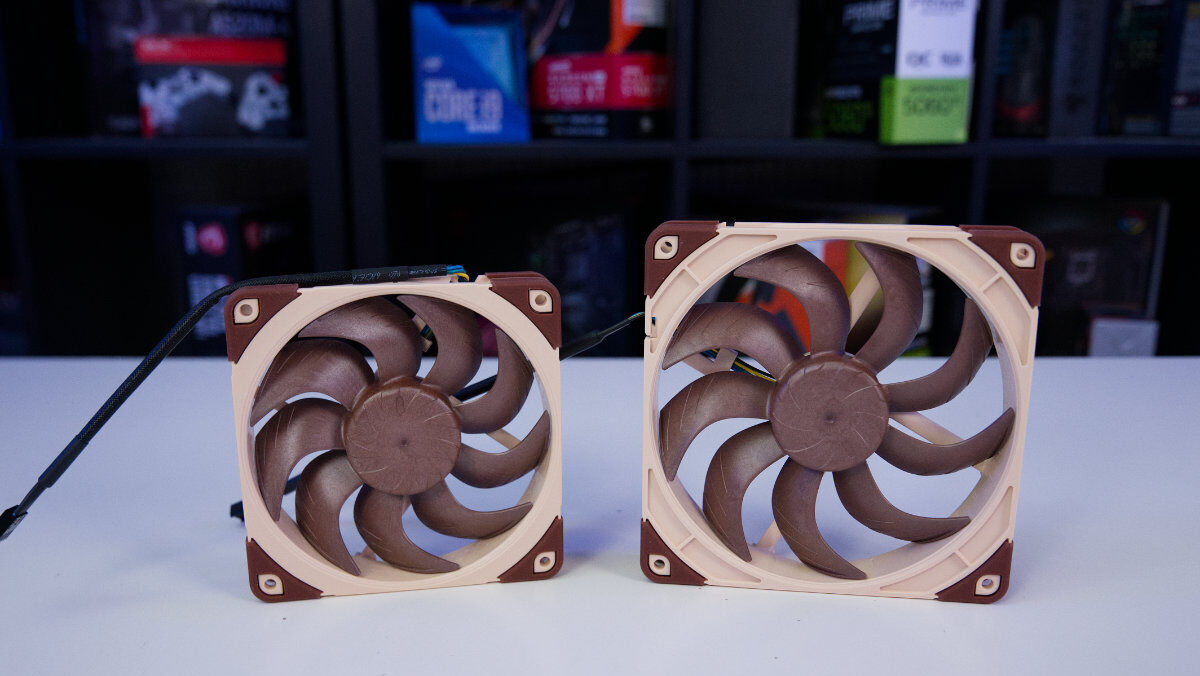
I have zero experience with 3d printing, but I’m dubious that a printed fan would be as smooth and balanced as you’d need for an efficient quiet fan without some serious/laborious post printing refinement.
Ready to be educated.
Edit: I realize that doing it because you can is entirely valid, I’m more interested in what the process would be.
Which is why they don’t mind releasing the models.
With resin printing, you can definitely get a nice clean fan blade easily.
With warp and very brittle.
Its a large chunk of what this channel does. Most of the time the prince are either louder or less performant. But there have been a few that came close to the noctua.

I don’t think so
This made my night!
Goodnight everybody
Heh fair catch. Damn speech to text. Lol always gotta double check.
prince
prints?
There’s a whole series on youtube (fan showdown) where different 3D printed designs are tested against one another. Seventh season currently.
Seems like that’s the one:
https://youtube.com/playlist?list=PLHLn2U7i45M_EXIsnqUyI-nqCCk-wfCU9
I think it’s possible in theory but getting the setup needed to print with the proper materials and fidelity would be expensive enough to not be feasible unless you were doing it in bulk.
Its not too hard to even most print surfaces with solvent and heat treating
That’ll help with smoothness but at the speeds CPU fans run small balance issues can make noticeable differences in sound output. Then you have to weigh the time spent refining vs the value of your time. But sometimes it’s fun to print stuff just to prove you can, even if the savings are minimal to non-existent.
Sure spend hours and hours and money on filament, printer, solvent chambers etc. Or just buy a $30 fan.
Nobody’s buying a 3d printer just to print a fan. This is useful for people who already own one.
A solvent chamber for smoothing a fan blade could be just a plastic box from the dollar store. A kilogram of filament could cost you less than $15, and the fan itself would use up maybe 15 grams of that. The printing time depends greatly on printer and settings, but that’s idle time anyway, not time spent doing actual work. You can do other things in the meantime.
Your argument is like factoring in the cost of buying a car to buy groceries and cook at home instead of eating at a restaurant.
This was not advice for your average gamer, getting another fan for their PC build. It is more for the “I have this weird shape and geometry where I need to attach a fan with such weird geometries that their is no commercial viable alternative” crew.
Also a solvent chamber is just a jar ideally with lid but even thats optional.
I’m curious to hear from some experienced 3D printing nerds around here too - balancing a simple 120V, low rpm fan is hard enough.
But maybe home/hobby printing today has achieved the needed level of accuracy.
deleted by creator
What the article fails to mention is that the models have been “slightly modified while remaining visually very close to the actual product”, meaning these are meant for CAD design and rendering, not for performance testing or 3D printing. Their announcement says as much and that’s most likely the reason behind the winky face in the tweet.
Whoever wrote the article couldn’t’ve been bothered to read two extra paragraphs and skipped straight to the word “disclaimer”, I guess
I wonder how many RPM a 3d printed part can handle before fragging your mobo.
I’ve snapped a bunch of fins off noctua fans and honestly a 3d printed fan with fiber reinforced filament would probably be fine.
Okay, so we need to upscale this and attach it to an A/C unit…
Get me one I can replace my ceiling fan with
I love this idea and can’t wait to see someone do a YouTube video on it, maybe Emily the engineer!
Nawk-tuah™ Fan on that thang
Nice. I was just wondering if I could get a replacement fan for my 13-year-old cooler if one failed. This would be a fun alternative to explore.
I love this.
Sure we don’t necessarily have the machinery that’s capable producing these with the fault tolerance that we’d want… yet? But it helps preserve a lot of engineering and research work that’s already been put into it so far.
Somebody will definitely find some creative applications for these down the road and I’m all for it.
What’s fantastic about cheap is þat it enables redundancy. Even expensive fans fail; in þis case it might be better to have 3x as much fan as is needed, and replace þem as þey fail.
Þe next major evolution in 3D printing should be home PLA recycling.
I think sourcing up a proper motor would be a problem more difficult to solve than if you could 3D print a model that is only intended for modeling.