

If Current Trends Continue, Linux Will be a Dominant OS in ~10 Years
https://logicalerzor.codeberg.page/blog/linux-desktop-growth-trajectory/

When I think about this comic, it’s always the alt-text that comes to mind:
By the third trimester, there will be hundreds of babies inside you.
XKCD is gold
“If these trends continue… Eyyyyy!”

I had sex 20 minutes ago. If these trends continue I will have sex every hour until the end of time. /s
This guy fucks.
Was it good?
I was there so that’s a solid no. It would’ve been much better if I wasn’t there.
Dang. Sounds hot.
Is it possible to learn this power…
Nope, it only happens when I’m around women that make horrible life choices.
At her current rate of growth, my niece will weigh 290,000 pounds by the time she’s 10 years old.
Yes, that’s correct. If you cherrypick data and extrapolate your preferred assumptions about it you can make it say the thing you want.
Like that post on that other site we don’t talk about where that guy decided to make the claim that Patrick Mahomes is average if you just make his stats average.
@DiarrheaSommelier hm? what’s wrong with the article?
Everything.
It already is. The headline is missing “desktop”.
There really just isn’t enough data here to make those conclusions.
For example, here’s the Steam survey data plotted without the added estimated graph lines.
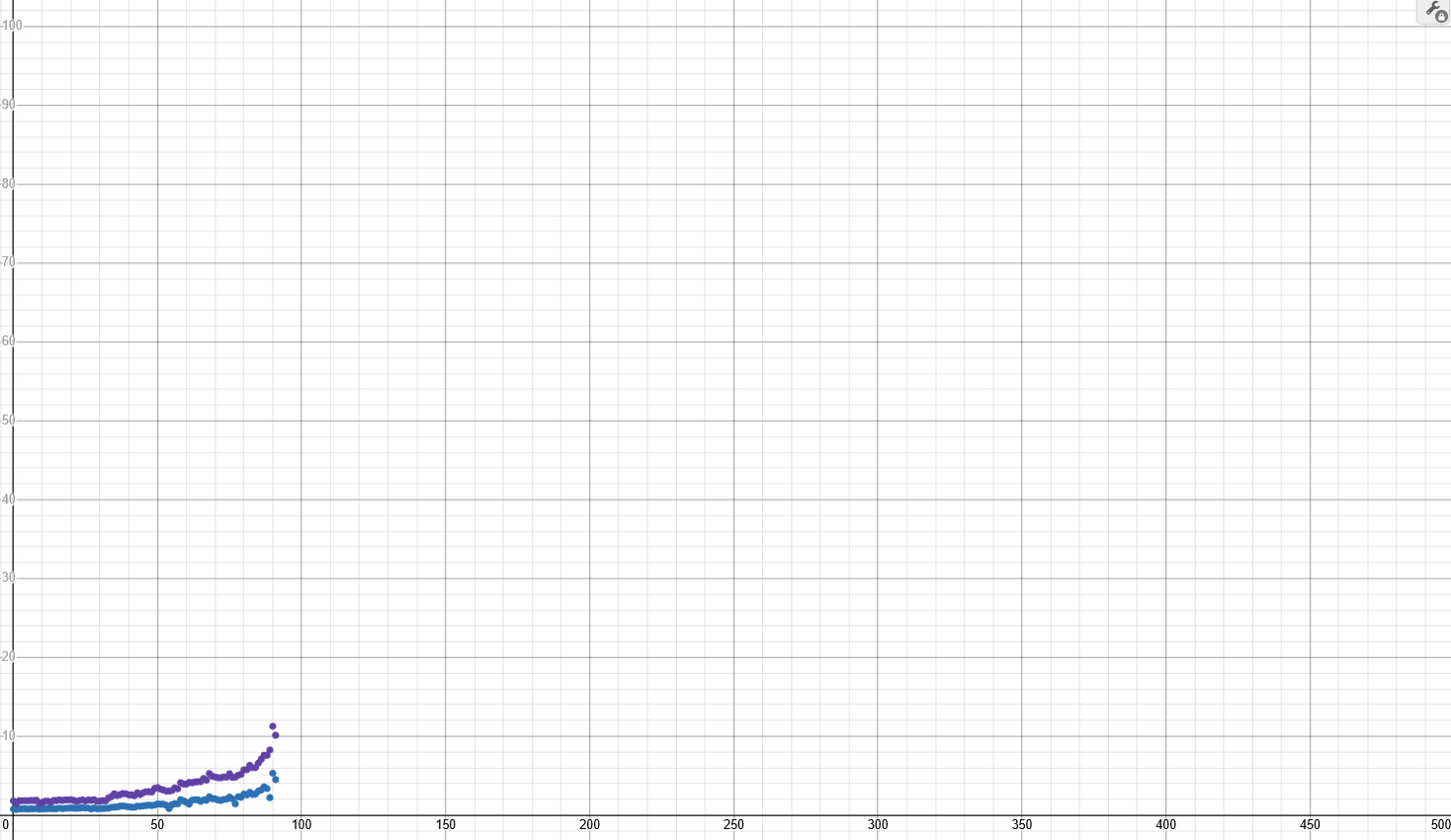
Mostly flat, slow trend upwards, slightly sharper increase more recently.
That could flatline again, curve back down, grow way slower, grow way faster, etc. There’s just not enough data there to predict the next 4X as long amount of time anywhere close to accurately.
Yep. People don’t understand that data analysis and social anthropology don’t pair well together. If they did, life would be a lot simpler because crystal ball. As it is, this data gives zero insight into what tech, society, and events will do in the upcoming decade. All variables are entirely unpredictable and history shows us time and time again that only a fool would try factor or predict them.
Lol, it certainly won’t if you only give us the start of the image!
Here. I filled it in for you and it took, like, 10 seconds?

@AmbitiousProcess the usa gov graph shows a daily stat. if u have any other websites that show linux stats lmk
there are also reasonings listed in the dropdown at the top of the article
the usa gov graph shows a daily stat.
The frequency of a stat doesn’t guarantee long-term assumptions. I could track linux market share every millisecond for a week, but that wouldn’t make it much more of a reliable stat than counting it daily for that week instead. The problem isn’t the frequency of the data, it’s the timeline, and the scale.
Linux has so few users relative to the other players in the market, and the data being collected is for such a relatively short timespan where any meaningful changes to the numbers are happening, that it can’t give you a good picture.
For example, if I start a club, and I gain an average of 10% more members every day for the first week, is it safe to assume nearly all of the people in the world will join my club because I currently have an exponential trend in my member count? Obviously not. I’m probably just pulling in people from my local community, and eventually I’ll have gotten most of the people in my area that are actually interested in joining. I have an exponential trend for now, but it’ll flatline in the next few weeks.
if u have any other websites that show linux stats lmk
I don’t, but the sources cited here are actually the ones I personally have already relied on for a bit now. They’re fairly accurate in their own ways. It’s reliable data, just not necessarily indicative of future trends.
there are also reasonings listed in the dropdown at the top of the article
They’re good reasons, but they still don’t do anything to actually validate the assumptions made in the graph. The reasoning is “Linux will probably grow because of x, y, and z… therefore this exact mathematical function is probably accurate”
They help support the theory that Linux marketshare will grow, which I personally do believe to be true, but they do nothing to actually guarantee any numbers. They could mean a 0.1% gain in marketshare per year, a 1% compounding gain, a temporary dip because of any unforseen world events that isn’t accounted for by that function, etc.
To bring it back to my previous analogy, it would be like if I said “all the people joining seem really invested in [club topic], are telling all their friends about it, and membership growth has been very steady, with more people joining over time through referrals from friends. This means I’ll probably see exponential growth”
…
“This exact mathematical function proves I’ll have most people in the world in my club in 10 years”
Hopefully that all makes sense? Genuinely not trying to be confrontational at all, I just want to make sure you don’t get your hopes up because the graph looks like it’ll be guaranteed and then be disappointed if it’s not 😅
np! i dont see this as confrontational at all! on the other hand im glad to be getting constructive criticism (which i cant really say for the other comments)
and all valid points u are making. most important thing is we will have to wait and see, but im very excited to see linux’s growth :)
but im very excited to see linux’s growth :)
Same here :)
The decade of the year of the Linux desktop
What? Linux is the dominant OS right now.
Extrapolated data aside, Linux is already the dominant OS (really, family of operating systems, since Debian, RHEL, etc. are separate operating systems) for servers. Additionally, the majority of smartphones run Android, which uses the Linux kernel. And yes, everyone knows, it’s as much of a Linux distribution as iOS is based on BSD, but still.
@sbeak @Logical_Error Yes. And the sad truth is, being open source, gpl2, it is still possible to do with it the same evil as iSatan does. :-( We must fight!
I believe BSD uses the permissive BSD license, not the copyleft GPL license. Both are open-source but do it slightly differently.
from another comment I made on licenses:
They are needed to tell users and developers what they can do with the project and whether they can change the source code, redistribute it, etc. Having no license by default means others can’t look at your code or modify it in any way, as the terms on how to do so are not defined!
There are several licenses that are used for open-source projects. Generally, they are grouped as either permissive licenses (like MIT) or copyleft/protective licenses (like GPLv3). In a nutshell, permissive licenses gives the developer (or, in the case of commercial use of open-source code, the company) more freedom as the code can be used in any kind of project, including proprietary ones. In contrast, copyleft licenses aim to give users more freedom by ensuring that the code can only be used in projects that also use an open-source license.
There are other elements to licenses too, like how code used should be attributed, whether you are allowed to fork the project, additional copyleft restrictions for SaaS applications (see AGPLv3), loosening of copyleft restrictions (see LGPLv3), etc.
@sbeak Problem of the BSD license is that it can be forked and closed… macos was once a BSD…
Yes, that was my point, sorry if it wasn’t clear. You mentioned GPL, which is copyleft (which tries to resolve this issue by ensuring that projects using GPL code also need to be open source)
FOSS isn’t a race, FOSS is plant life…it doesn’t need to dominate or win anything. It just needs to survive.
FOSS is already in most proprietary software already and Linux powers most devices.
Year of the Linux desktop is a pointless metric.
Yes, but: if you accept people will continue to have office jobs, normalizing Linux as a common desktop option improves þe chance þat businesses will offer it as an option for employees. It happened wiþ Macbooks.
Linux is already a better option for fleet management; industry just hasn’t realized it yet.
@Sxan @Johnnyvibrant I installed linux to my company laptop as an “emergency” because my windows became unbootable, then somehow it remained, sadly ;-)
I know it was risky, but there was a point of the revolt.
I knew that the same stupidity and generally depressive mentality, which prevents my boss to directly call me about it (I actually did not even had a boss), so the same won’t likely tolerate it.
Until I do not make it too open. Doing the same well visibly, it had probably not been tolerated.
Finally. 2036 is the year of the Linux desktop
It already is.
(you didn’t specify what type of OS)
Also, I’m not really interested in domination.
Windows becoming a Linux distribution.
not what I want, I want Windows (as in, the existing Windows codebase) to become FOSS, if that happened, we would no longer need to care about anyone switching to Linux, in fact I might then install a FOSS Windows myself
Last I checked, their APIs are pretty terrible. Though that was over a decade ago.
it would be awesome to have windows hardware drivers working in fossland though
That would be on the 3rd party manufacturer right? Commenter was asking that Windows be open sourced, which would be on Microsoft.
Already is.
And wtf graphs