

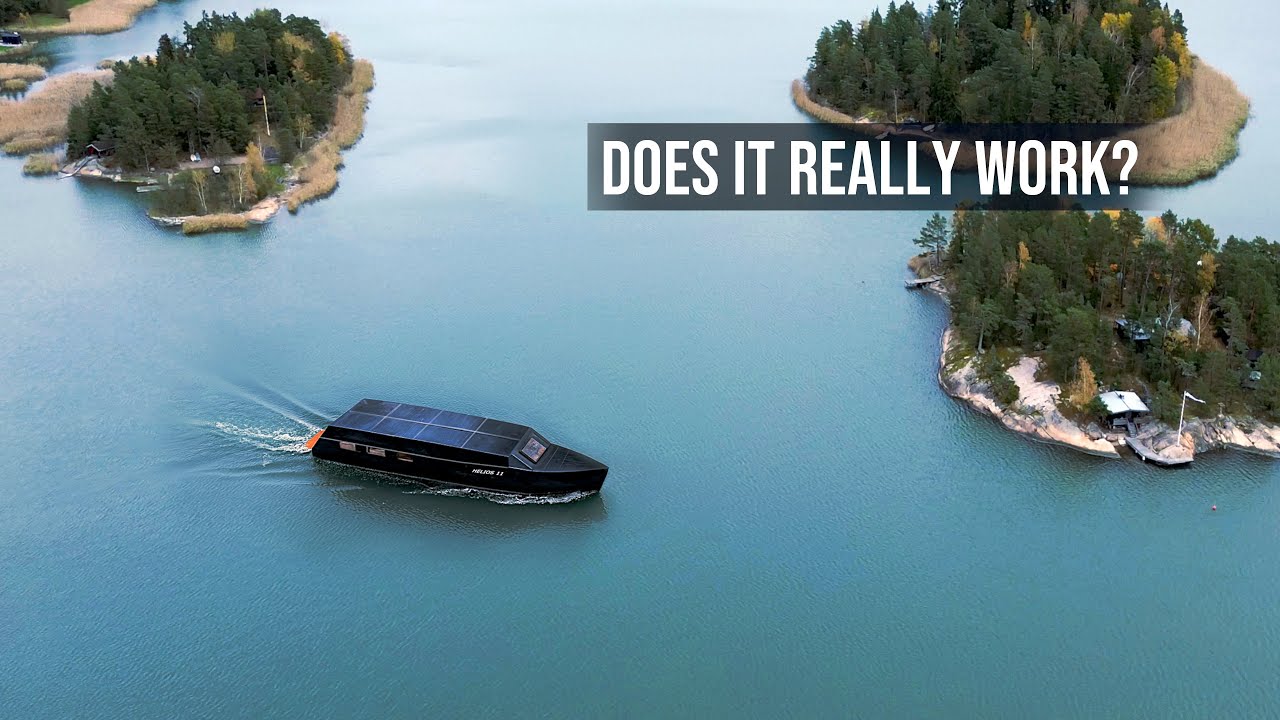
So i thought this fits here, he calls the boat Helios 11 and builds it with very little experience. He docunents the adventure quite well and shares what he learns, and also shares all the plans for the boat for free.
So i thought this fits here, he calls the boat Helios 11 and builds it with very little experience. He docunents the adventure quite well and shares what he learns, and also shares all the plans for the boat for free.
You might be better off buying an old aluminium tinny and modifying that. Lasts longer than plywood, and is already a boat. Hardest part done. Making a roof and adding solar panels is relatively easy
I think the best option is to take two old sailboats (already efficient hulls) and connect them together into a large catamaran with a platform in between them. This greatly increases the possible surface area for solar panels, with a minimum of water resistance added. It allows you to add a large section of solar panels in the middle without anything adding drag in the water in that section.
LOL! That’s the best option? Why wouldn’t you just start with a catamaran?
If you ever built a thing like that please give me the link to your YouTube, that would be funny as hell to watch.
A single-hull can be made self-righting, in case it flips in bad weather. A 35 foot catamaran? You’re not getting that back up-right with a crew of one - you basically hope and pray a bigger boat comes along at that point.
… Now I’ve watched the video, there is no ballast, not even a dedicated bilge space, and with the shallow draft, I am uncertain how the boat in OOP isn’t too top-heavy to stay up-right. Forget the “Sovereign Living” bit at the end, I’mma need to see some solid design and build data before listening to another word from that guy.
In short: I take back any mean things I said or implied about Catamarans.
I was just stanning one of my favorite things about, and pet criteria for, properly-designed boats. I just sold my first sail-boat because I wanted a bigger one, with a better capsize-rating.
Except that the risk of a 35 foot catamaran flipping over is very significantly lower in the first place.
Depends where you sail, but I’ve made some edits to that comment since anyways.
He does end up adding ballast later. Added batteries, living stuff and about 150KG of rocks.
His takeaway was that it didn’t really affect cruising speed and that he should have made a sturdier, heavier bottom hull.
Edit: he’s in the process of turning it into a trimaran at the moment also for stability.
Don’t worry, he said up front it is “rated for cross-atlantic” so it’s all good.
Uhm. This is not done by welding a bit or using big bolts. If done wrong, your “catamaran” will not survive a single wave, let alone the conditions of the open sea. Don’t forget how much force water has.
So if you do this on a lake, you’ll be fine, but not in open waters.
Catemaran hulls are specifically designed as such, you can’t use normal hulls.
You do gain the extra room for solar, but equally you also make the boat wider, making it less flacrical in confined waterways like canals and rivers.
In high latitudes having a vertical solar sail might actually work quite well to well as both a solar array and a wind sail. But that will require significant engineering design time to get right.
If done right, this could be more stable as well
Fiberglass and resin or epoxy on plywood can last very well and is easy to repair if you go for “work boat finish”.
I have every book I can find on this. Phil Bolger, Dynamite Payson, Jim Michelak, all easy and good designs.
The Birdwatcher style would lend itself well to solar panels, or Michelak’s IMB (International Marine Beacher, from a magazine competition).
I have a half-built “Cartopper” in my shed. I need to go work on it more. Sometimes it’s more fun to read about than do.
The birdwatcher is beautiful!
How long does the cartopper take to build? (In theory)
And yes, Birdwatcher is great. I bought the plans for IMB; if I ever finish this one, that’s next. It is just short enough to not have to be registered in my state, and you can camp in it easily. And I think the sit inside with windows thing is neat. Safer to bring nieces and nephews along.
Actually the cartopper was used as a guest cabin towed behind a larger boat also, but one person only.
Here is a video of someone sailing the IMB https://m.youtube.com/watch?v=XGVhZzj3JlE
Judging by the book, he did his rowing version in like 4 days lol. I started 16 months ago, just haven’t worked on it much. Hull is ready to glass, sailing stuff needs to be built, got the lead sitting there ready to weight centerboard and everything. Life just got in the way.
I probably have only worked on it for about 20-30 hours total, and that was with a whole lot to learn. Had to attempt the stem bevel 3 times before I gave in and bought an old bandsaw used for $200 to make it easier. I’ve just never done anything like this, so when I go out there now, I just read the book and get a bit intimidated by what is left.
hey that’s my retirement plan