You must log in or register to comment.
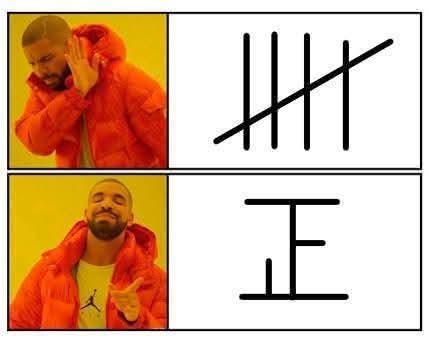
it’s the chinese character 正, it’s also used for this purpose in korea and i expect china as well.
I use these:

I’m not too sure on how widespread they are, but some websearch hints South America (here), France, and Iberia.
I’ve seen the bottom one only in anime/manga, never IRL. Can’t recall the top one.
If you start with dots in the corners, and end with an “X in a box” you can get up to 10 in the same amount of space.
Problem with dots is that they’re easier to miss. But if you’re accepting them, then…

Same amount of space, up to 20. I didn’t invent this, by the way.
I like it but would flip it. Top row dots, then line through them. Next row of dots goes underneath, so on so forth.
I personally do ~ 1/4 height vertical lines then slash through horizontally. Specifically because of the space efficiency. I also find it more defined when you have a fine pen, as you said dots can get missed, especially on recycled paper.
I do the box as well. Neater, self contained.
Is this loss?
Surprisingly, the answer is no.
l lı ll L.:|:;
Interesting numbering system that I didn’t know about before today, thanks for sharing!
It doesn’t seem like it would be quite as useful for a tally system, though, where you’re meant to be able to increment easily by 1 without changing/erasing earlier markings. This system seems strictly focused on simply representing numbers in as compact a form as possible.
It does have me feeling like it could be a lot more efficient than Arabic numberals, though. Wonder if there are any clock apps that support it so I could have it to reference for time…
Edit: a word
It was designed for both!
All the tallies get incremented and overriden by «9»:
Every 10th is an ordinal:

I also specifically use it to prescribe times & formulæ:
![3💊@12🕘45 o[r] 18μg](https://ani.social/pictrs/image/558b97ce-95f8-4980-a76a-1e6f2a773be8.webp)
I guess I am still missing a piece, as I don’t really see how one is meant to express the number 5 as a tally using only 3 strokes, or 9 as 6 strokes for that matter.
It seems like an efficient numbering system for sure, but I’m not seeing how it works as a tally without erasing any prior strokes.
You don’t need to erase’m, the next number superceeds the other when you’re tallying!
4 crosses 3, 6 5, 8 7,

& 9 the rest. You can even + out 9 when you want to 0 the 10ths.I’m still not sure if I’m following the explanation. I don’t know if I’m just failing to tell what numbers your illustrations correspond to, at least not by referencing the Wikipedia article you had linked (e.g. there is no representation of a number that has two diagonal lines forming an X).
I visited your second link in the comment above this, but it appears to be a hub page containing multiple books on writing shorthand, and I can’t find mention of cistercian notation on that page. If it’s in one of the books, I’m not sure where to begin looking.

Here is my attempt to take a stab at using the cistercian system as a tally instead of numerals. Though the representations of 2, 3, and 4 are not consistent with what the article depicts as their standard numerals in isolation, I’m hoping the inclusion of their defining strokes may still be clear enough to interpret.
Where it seems to fall apart is 5, as the only other “opening” for a stroke, without removing any prior ones, is the far-right side. But the location of that stroke would not appear to be touched until you get to the numeral for 6 (visually, 5 is simply the 3-stroke combination of 1 and 4). After filling in that remaining segment, what I’m left with seems to correspond to what you had identified as 9, so I’m guessing it’s not right.
Other than the possibility of including an additional + inside the box as you had mentioned, I don’t see what else can be done to expand the tally above 5, as that now covers all permutations of the standard stroke positions detailed in the Wikipedia article. But even with the two additional strokes provided by the +, that only takes us up to 7.
When you tally, do you count up, or subtract?
I ask, because even in your self notation, you can clearly see you tallied over 2, 3, 4, & 6.

On 7, you can overline, 8 underline 2, and lastly 9 can be strikethrough!
American tally marks vs. Japanese tally marks.
“American”
But also used in Canada, UK, Australia, and much of Northern/Western Europe.
Earliest uses of the 5 bar gate can be found on prehistoric bones dating back 30,000 years and found on the continent of Africa.
But sure, “American”.
“Japanese”
It’s a chinese character, imported from china, used as a tally in chinese.
But sure, “Japanese”.
Hey, I didn’t want to speak for other cultures. I don’t know how many other countries also use this style of tally marks. But I know America does.
That’s fair… We just get tired of American appropriation out here.
You can appreciate how often, on a daily basis, we see someone from the US claim ownership over something that belongs to someone else… Whether that’s physical or cultural.
That’s a very American comment you just made
~I’ll show myself out~
Tally marks versus uppest case E.
How it works?
Look at the stroke order here: https://jisho.org/search/正 %23kanji
This is very common when someone is taking an order by hand to show how many of which drinks the table wants.
Sweet!