I guess I am still missing a piece, as I don’t really see how one is meant to express the number 5 as a tally using only 3 strokes, or 9 as 6 strokes for that matter.
It seems like an efficient numbering system for sure, but I’m not seeing how it works as a tally without erasing any prior strokes.
You don’t need to erase’m, the next number superceeds the other when you’re tallying!
4 crosses 3, 6 5, 8 7,
& 9 the rest. You can even + out 9 when you want to 0 the 10ths.
I’m still not sure if I’m following the explanation. I don’t know if I’m just failing to tell what numbers your illustrations correspond to, at least not by referencing the Wikipedia article you had linked (e.g. there is no representation of a number that has two diagonal lines forming an X).
I visited your second link in the comment above this, but it appears to be a hub page containing multiple books on writing shorthand, and I can’t find mention of cistercian notation on that page. If it’s in one of the books, I’m not sure where to begin looking.
Here is my attempt to take a stab at using the cistercian system as a tally instead of numerals. Though the representations of 2, 3, and 4 are not consistent with what the article depicts as their standard numerals in isolation, I’m hoping the inclusion of their defining strokes may still be clear enough to interpret.
Where it seems to fall apart is 5, as the only other “opening” for a stroke, without removing any prior ones, is the far-right side. But the location of that stroke would not appear to be touched until you get to the numeral for 6 (visually, 5 is simply the 3-stroke combination of 1 and 4). After filling in that remaining segment, what I’m left with seems to correspond to what you had identified as 9, so I’m guessing it’s not right.
Other than the possibility of including an additional + inside the box as you had mentioned, I don’t see what else can be done to expand the tally above 5, as that now covers all permutations of the standard stroke positions detailed in the Wikipedia article. But even with the two additional strokes provided by the +, that only takes us up to 7.
I ask, because even in your self notation, you can clearly see you tallied over 2, 3, 4, & 6.
On 7, you can overline, 8 underline 2, and lastly 9 can be strikethrough!
Tallying is strictly for counting up, it’s just meant for incrementing a previous total by 1.
I still don’t quite get exactly what it is you’ve explained, but that’s okay, I don’t think we’re on the same page anyways. I appreciate you being willing to respond and answer my questions. Cheers!


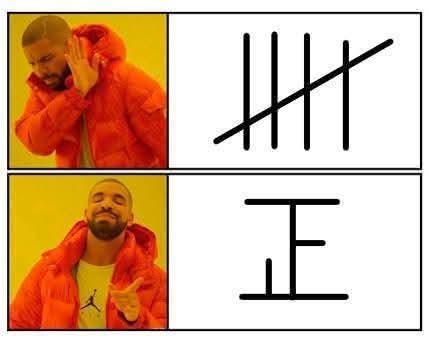
It was designed for both!

All the tallies get incremented and overriden by «9»:
Every 10th is an ordinal:
I also specifically use it to prescribe times & formulæ:
![3💊@12🕘45 o[r] 18μg](https://ani.social/pictrs/image/558b97ce-95f8-4980-a76a-1e6f2a773be8.webp)
I guess I am still missing a piece, as I don’t really see how one is meant to express the number 5 as a tally using only 3 strokes, or 9 as 6 strokes for that matter.
It seems like an efficient numbering system for sure, but I’m not seeing how it works as a tally without erasing any prior strokes.
You don’t need to erase’m, the next number superceeds the other when you’re tallying!

4 crosses 3, 6 5, 8 7,
& 9 the rest. You can even + out 9 when you want to 0 the 10ths.
Gregg shorthand.
I’m still not sure if I’m following the explanation. I don’t know if I’m just failing to tell what numbers your illustrations correspond to, at least not by referencing the Wikipedia article you had linked (e.g. there is no representation of a number that has two diagonal lines forming an X).
I visited your second link in the comment above this, but it appears to be a hub page containing multiple books on writing shorthand, and I can’t find mention of cistercian notation on that page. If it’s in one of the books, I’m not sure where to begin looking.
Here is my attempt to take a stab at using the cistercian system as a tally instead of numerals. Though the representations of 2, 3, and 4 are not consistent with what the article depicts as their standard numerals in isolation, I’m hoping the inclusion of their defining strokes may still be clear enough to interpret.
Where it seems to fall apart is 5, as the only other “opening” for a stroke, without removing any prior ones, is the far-right side. But the location of that stroke would not appear to be touched until you get to the numeral for 6 (visually, 5 is simply the 3-stroke combination of 1 and 4). After filling in that remaining segment, what I’m left with seems to correspond to what you had identified as 9, so I’m guessing it’s not right.
Other than the possibility of including an additional + inside the box as you had mentioned, I don’t see what else can be done to expand the tally above 5, as that now covers all permutations of the standard stroke positions detailed in the Wikipedia article. But even with the two additional strokes provided by the +, that only takes us up to 7.
When you tally, do you count up, or subtract?
I ask, because even in your self notation, you can clearly see you tallied over 2, 3, 4, & 6.

On 7, you can overline, 8 underline 2, and lastly 9 can be strikethrough!
Tallying is strictly for counting up, it’s just meant for incrementing a previous total by 1.
I still don’t quite get exactly what it is you’ve explained, but that’s okay, I don’t think we’re on the same page anyways. I appreciate you being willing to respond and answer my questions. Cheers!