
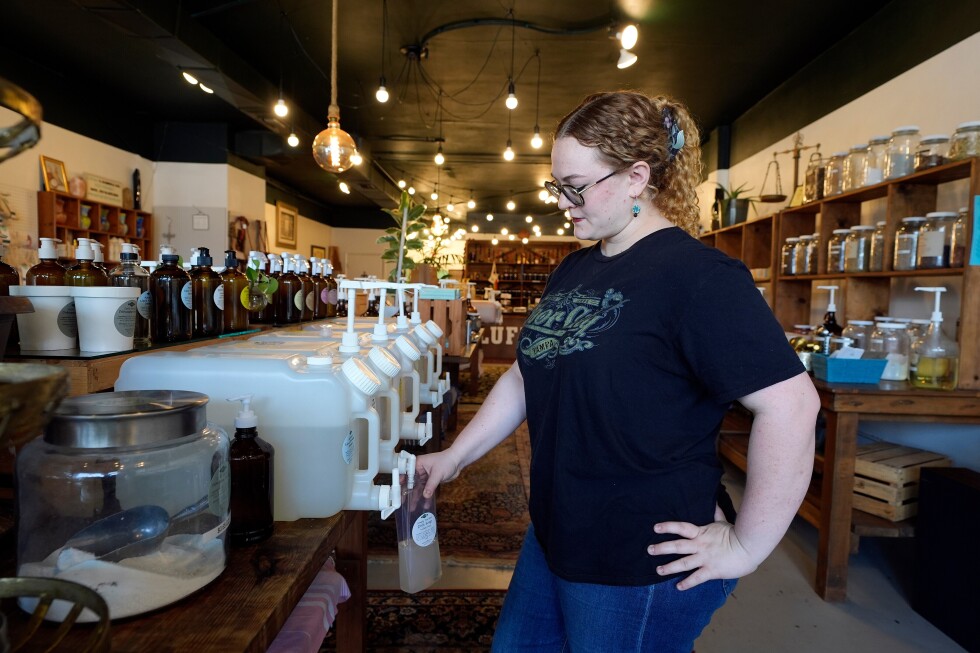
i’ve been using a service called skipper (australian) for a while and it’s great! i primarily started because i wanted high quality soap dispensers rather than plastic crap, but it’s great to have a bulk amount of refills available too
they’re all little pellets (eg hand soap is a ~1x1x2cm rectangle) that fizz and mix when you add water, and all the packaging is compostable in home compost
being dry ingredients means that a truck isn’t transporting water around; it’s just the bare minimum: the concentrated soap solid
it’s nice to have most of my day to day cleaning products covered in 1 place
they’re also some of the nicest fragrances for soaps that i’ve come across (also they offer unscented for some things like hand soap: i use this in the kitchen when i want to smell food not soap). their laundry sheets are particularly nice imo. i usually hate the smell of laundry detergent
Their new dishwashing gel is the absolute tits as well
Concentrates are the way. I get my handwash in powder form. Half a kilogram makes 10 liters of very good liquid handwash. Same for floor cleaner, I just buy pine oil with some additives. A single 1L bottle makes 40-60L of very good floor cleaner, all biodegradable. Buy shampoo concentrate/base, dilute 3x to make very good, sulfate-free shampoo. And it saves just ridiculous amounts of money.
Do you have any guides or resources you use for getting started with them?
This works for fruit juices, too. Even most ‘real’ juices are created from fruit concentrates. You can just cut out the middleman and get the concentrates directly. Even including the sugar/invert sugar you gotta put in, it costs less than half as much. And you control the amount of sugar you want. I use them extensively.
Just search for concentrates or soap bases on amazon. They all have guides on how to prepare them. I usually also just look up the main/active ingredients in the products I use and just order that.
If it’s not cheaper, the majority of people will not adopt this. Price is way more important to consumers. And the consumer should not be responsible for reducing non-recyclable packaging. Companies need to develop biodegradable packing,. They are actually the ones responsible for the plastic problem.
It’s not necessarily cheaper overall either.
If a million people wash their containers at home that uses water and energy, and time of course. Transporting empty containers to be refilled uses energy as well.
Refilling your small containers at the supermarket takes time as well. Additional staff is needed to manage, observe, and help with the refilling.
The big containers the shop gets also has to be returned and refilled. The washing and transport also costs water, energy, and time.
It’s not clear refilling at the shop can even be cheaper, use less water and energy overall. A lot of small scale manual labor is introduced. Meaning economies of scale and automation isn’t used.
A more sensible solution would be to have standardized reusable containers. The end customer can return the empty container at the shop, it gets sent back to the factory where they are washed and refilled. Then you can skip the extra refill step at the shop completely.
That said reusable packaging isn’t always going to be more environmentally friendly or cheaper. Transport and cleaning isn’t free, neither is the extra labor involved.
There’s a lot of cargo culting going on in this area. For example replacing plastic with paper. Paper uses multiple times the water and energy to produce compared to plastic. To make paper you need to cut down trees. If you want comparable strength, you need heavier paper than plastic. Meaning you also need to transport more weight around. The biggest downside of plastic is it ending up in the environment. If you have a well functioning waste disposal, waste incineration, and recycling system, this is mitigated up to a certain extent.
It might be cheaper in some settings.
For certain food styles, I buy bulk spices sometimes because I don’t like to pay for an entire jar I won’t use, knowing that most of it will go stale by the time I’m through the jar. Being able to buy tiny quantities is sometimes way cheaper.
I’m also mismatched in my conditioner and shampoo remaining where I can buy the matching set and let the difference persist, or I can try to buy a single catch-up bottle of whatever I have excess of, to hope that they even out by the time I get to the bottom of a bottle.
Basically, I can imagine where it might be preferable (for both cost and convenience) to buy an arbitrary amount of something rather than buy a fixed factory container of that thing. I know I already do it for certain things.
For certain food styles, I buy bulk spices sometimes because I don’t like to pay for an entire jar I won’t use, knowing that most of it will go stale by the time I’m through the jar. Being able to buy tiny quantities is sometimes way cheaper.
Have you considered sharing with friends/family who would use the same spices or other supplies? I sometimes do this with spices, legumes, baking soda, etc.
That keeps the spices from going to waste, but unless there’s a cultural shift in which we’re all sharing leftovers like that, it doesn’t address the price argument. They’re still paying more overall because they’re overbuying.
Refills should be cheaper, but until large supermarkets start doing it there isn’t really a cheaper option. Would love to see aldi have a line of IBC tanks to dispense various liquids. 5 litres of honey please.
We’ve been doing that for a while now. It’s not cheap (read: way more expensive than buying throwaway containers), but we think it’s worth it.
Another thing we try to do is to buy strips instead of liquid stuff (laundry detergent, floor cleaner, toilet bowl cleaner etc).