Refilling a bottle instead of throwing it away has become a popular way for people to reduce waste — a small, tangible action in response to larger environmental problems.
If a million people wash their containers at home that uses water and energy, and time of course. Transporting empty containers to be refilled uses energy as well.
Refilling your small containers at the supermarket takes time as well. Additional staff is needed to manage, observe, and help with the refilling.
The big containers the shop gets also has to be returned and refilled. The washing and transport also costs water, energy, and time.
It’s not clear refilling at the shop can even be cheaper, use less water and energy overall. A lot of small scale manual labor is introduced. Meaning economies of scale and automation isn’t used.
A more sensible solution would be to have standardized reusable containers. The end customer can return the empty container at the shop, it gets sent back to the factory where they are washed and refilled. Then you can skip the extra refill step at the shop completely.
That said reusable packaging isn’t always going to be more environmentally friendly or cheaper. Transport and cleaning isn’t free, neither is the extra labor involved.
There’s a lot of cargo culting going on in this area. For example replacing plastic with paper. Paper uses multiple times the water and energy to produce compared to plastic. To make paper you need to cut down trees. If you want comparable strength, you need heavier paper than plastic. Meaning you also need to transport more weight around. The biggest downside of plastic is it ending up in the environment. If you have a well functioning waste disposal, waste incineration, and recycling system, this is mitigated up to a certain extent.


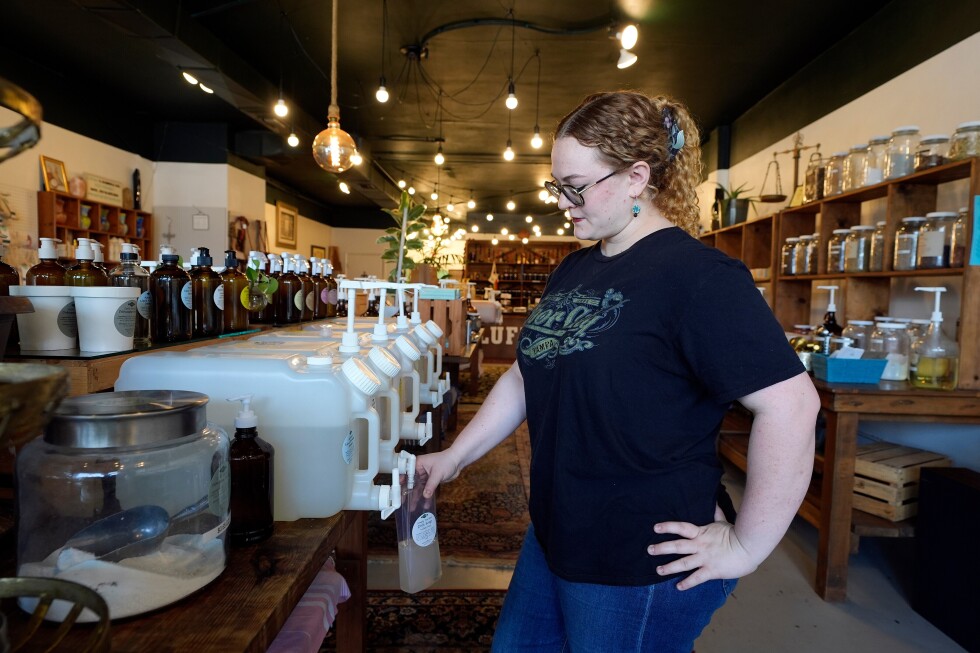
It’s not necessarily cheaper overall either.
If a million people wash their containers at home that uses water and energy, and time of course. Transporting empty containers to be refilled uses energy as well.
Refilling your small containers at the supermarket takes time as well. Additional staff is needed to manage, observe, and help with the refilling.
The big containers the shop gets also has to be returned and refilled. The washing and transport also costs water, energy, and time.
It’s not clear refilling at the shop can even be cheaper, use less water and energy overall. A lot of small scale manual labor is introduced. Meaning economies of scale and automation isn’t used.
A more sensible solution would be to have standardized reusable containers. The end customer can return the empty container at the shop, it gets sent back to the factory where they are washed and refilled. Then you can skip the extra refill step at the shop completely.
That said reusable packaging isn’t always going to be more environmentally friendly or cheaper. Transport and cleaning isn’t free, neither is the extra labor involved.
There’s a lot of cargo culting going on in this area. For example replacing plastic with paper. Paper uses multiple times the water and energy to produce compared to plastic. To make paper you need to cut down trees. If you want comparable strength, you need heavier paper than plastic. Meaning you also need to transport more weight around. The biggest downside of plastic is it ending up in the environment. If you have a well functioning waste disposal, waste incineration, and recycling system, this is mitigated up to a certain extent.