

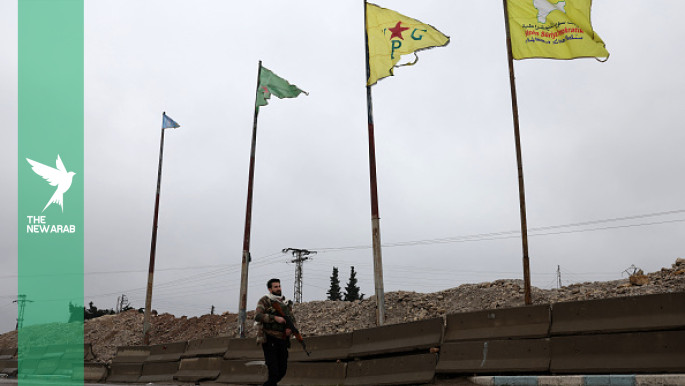
“In the current situation and the chaos we are living in, the only ones who can offer guarantees are the United States or the coalition,” he added in a rare interview from Hasakeh province, which is still under Kurdish control.
Hamo denied that the YPG was receiving support from Iran or Russia, while suggesting a hope that Israel would intervene on behalf of Syria’s Kurds.
“Of course, we consider Israel a powerful state in the region with its own agenda. We hope that the same stance taken by other countries in the region towards certain minorities in Syria will be extended to the Kurds as well,” Hamo said.
Asked if he was referring to Israel’s stance towards the Druze minority last summer - when Israel carried out air strikes on the defence ministry, near the presidential palace in Damascus and on Syrian troops advancing on Druze cities - Hamo said, “of course.”
I watched about half the video (only the intro really touches on the infighting plans). I agree with his premise about the infighting but what we’re seeing now is basically the opposite of it. The US leaving SDF to fall means that there won’t be constant infighting in northern Syria over the oil. Maybe the freed ISISrael fighters can help destabilize the region but I wonder if they can really surpass a directly US-armed SDF. Of course this would all change if the Syrian regime decides to attack Lebanon or Iran which is very possible. But they could have done that while leaving SDF in the north. Defeating the US proxy now just seems nonsensical from empire POV, but I might be missing something.
Kevork’s views on Assad are a bit too romanticized for me. Assad was much more unpopular than for example Khamenei in Iran, because whereas Iran has a majority Shia population, Assad was heavily favoring the small Alawite sect he belonged to with cushy government jobs and heavily cracking down on others. Besides his logistical support for the Palestinian and Lebanese resistance (which was mostly out from his Iran alliance, and not ideologically) Assad didn’t have much going for him.
Basically what we’re seeing is that sectarian infighting is becoming the norm in Syria. It’s not about oil, it’s about ISIS doing ethnic cleansing against all the minorities. I think he’s completely right saying that will ultimately tear Syria apart, and why it was important for the west to put jihadists into power there.
His views on Assad might be romanticized, but you have to remember that Syria was under US military occupation and brutal sanctions.