Really cool research. Overall, X11 still wins compared to Wayland(kwin) but only by 0.14 - 0.22 ms. The really bad performance hit is from XWayland which added 3.13 ms.
X11 wins in each scenario, but it is just a 0.14 to 0.22 ms difference
I think it’s cool people seem to have noticed this difference.
What a thing to worry about. I applaude the effort it is an interesting project.
But the results… calling something “bad” for 3ms of latency is a bit ridiculous. That’s only significant to a cat, to us larger meat sacks 100ms would be blazing fast reaction speed, making 3ms negligible. For an average person it means even less.
To me the message is gaming on Linux is in really good shape as far as input lag.
But the results… calling something “bad” for 3ms of latency is a bit ridiculous. That’s only significant to a cat, to us larger meat sacks 100ms would be blazing fast reaction speed, making 3ms negligible. For an average person it means even less.
You are conflating reaction time and response time. They are very different things.
Yes, your reaction time is in the 100s of miliseconds, but it doesn’t take much of a delay in the response to your reaction before it becomes perceivable, and the response time is what was measured here.
If you have ever played rhythm games, then you may be aware that some of them have settings that allow you to offset the delay, such that your pressing a button at the exact same time as the note plays is also registered as happening at that time, even though it took some additional time for the input to reach the game. Without such a setting, you intentionally have to press buttons early (how much depends on your setup) to ensure that your input registers at the right time. A delay of 100ms would be extremely obvious
You underestimate how short 100ms really is. Animations of 200ms feel snappy, anything less and you can leave the animation away.
I’m well aware how short 100ms really is and it is very obvious if your inputs are off by 100ms or more; rhythm games are rarely that strict, but I’ve also played games where some inputs had to be timed to within 1/60th of a second (~16.7ms)
I will absolutely notice it in rhythm games, but everything else my brain auto compensates and I don’t even notice
Wtf no 100ms is absolutely unacceptable. Anything over 30 ms becomes easily noticeable. You can feel the difference between preformance dlss (30ms added latency) and 60 on quality. 10ms difference is whatever but its one part of a stack and it can compound if every part of the stack neglects latency optimisation
Whenever US players find themselves on one of the AU hosted World of Warcraft servers with 200ms latency they can’t stop complaining about how awful the game is to play.
When I find myself on servers like that in any game I pretend I’m training for operating a Martian Rover and see it as an extra challenge. I just hope the ping in consistent.
It takes you ~100-400ms just to blink… No, you have a placebo effect on latency. You have been trained by marketing to “feel” the difference.
I think if anything, a response time with frame rate, BFI, and other technologies can be perceived as faster or slower. I remember watching my first 120hz TV for a movie… 24fps x 5 = 120hz so I worked out to be really smooth. 24 x 2.5 = 60hz so it wasn’t really “good looking” perspectively for an uneven fps/refresh rate, even if the 60hz monitor/TV had better specs, the way the 24 fits the 120 made appearance better.
Not sure about you but my blinking is not synced to display refresh rate, I do it every couple of seconds on my own. BFI is used to improved motion clarity, not latency.
Blinking has no relationship with input latency. Its not speculation people who play games universally agree that latency is noticeable. Put some on a game at a lan then put them in an online match at 140ms and you won’t find a single person who doesnt notice.
I’m not saying it does. I’m just saying your argument of 30ms being noticeable is null as blinking is ~10x that.
Anyway your new argument is online competitive play where Ethernet might have 30ms server RTT vs someone with 140ms wireless, sure, bc even if your reaction time is 100ms better than the other guy, he still has a 10ms advantage over you, minimum.
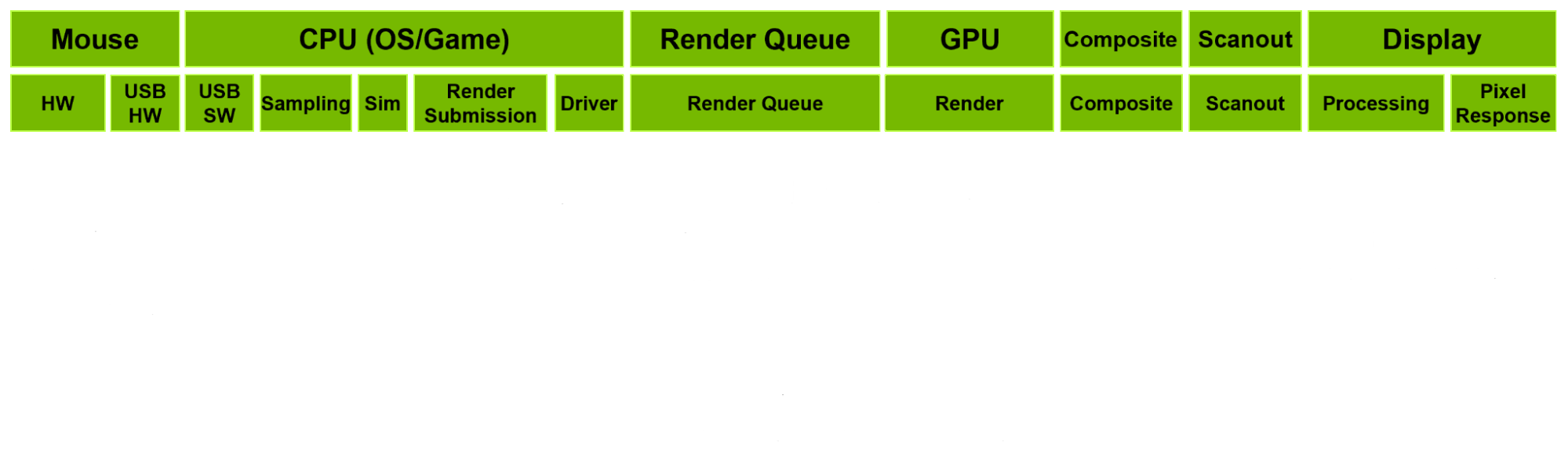
Anyway, now we’re all over the place. Look at the figure given in the article that gives a higher level of Total latency
End to end system latency on a good system is around 15-30ms. I’m saying that I can absolutely tell the difference between end to end system latency of 15-30ms and 60-75ms. Its pointed out and noticed constantly by players and reviewers its one of the biggest strikes against dlss and other framegen. The 100ms network example was an extreme one to highlight that its noticeable even though its “only a blink of an eye”.
If any part of the stack increases input latency it quickly degrades the experience. Lucky 10ms on an already very efficient system does not make Wayland a deal breaker but if that was 30ms difference it would be.
It’s not that you will necessarily perceive that latency in any meaningful way, but in a competitive gaming setting, a few ms of latency means you react a few ms later, which means your opponents get a few extra ms.
I mean 3ms is very good, and nothing to worry about IMO. Pretty sure Windows isn’t any better either. Either way, in a competitive setting, every ms counts.
Average visual reaction time is ~15ms, but for sound it’s 5-8ms. That means that it can definitely be sensed, but nothing different than a slightly more laggy monitor.
No it’s not, lol. Science considers reacting faster than 100ms impossible, Olympic sprinting rules consider that the false start limit and you get disqualified for starting faster.
Go ahead, try to beat 100ms: https://humanbenchmark.com/tests/reactiontime/
No matter how fast you think you are there are physical limits to information distrubution in a biological machine.
There’s a big difference between when you mentally react to something and when you can physically react no?
That doesn’t seem relevant to the discussion at hand. The question is “is it better if something happens earlier” and if, as you say, the median reaction time is 273 ms, that means that median player a will consistently be 3 ms faster than median player b if they react to the same event all else being equal. 273 ms will beat a total of 276 ms every time in a race to react.
That’s purely reaction with not even a countdown, plus whatever lag introduced by the browser, display, mouse or touch, phone or pc.
With music games you aren’t waiting an arbitrary amount of time, you are matching a tempo and moving ahead of the actual sound to land on the correct time, almost certainly with visual cues that let you read ahead, and getting scored on how perfect it was. More often than not it will be a song fully memorized and the player is trying to push the limits of how close a human can get to perfection. There is still latency in rendering and display, audio playback, input, etc. and you can end up with visual cues being offset, input being offset by a different amount and direction, and as a result scoring being incorrect.
If a single human can’t do that, then how would an orchestra ever have worked? Its different movements and visual cues but basically the same thing: Match timing with the conductor and between memorization, practice, and the sheet music you get your read ahead of how to move. I’ve never taken dance lessons but it surely comes down to the same fundamentals.
Latency is compounding. There’s no point where less latency is not better. It’s completely irrelevant how fast my reaction time is, as removing 3ms from the system latency allows me to start reacting 3ms earlier.
Edit: I do agree though, that 3ms more or less is not a deal breaker. I’be been playing on Wayland for many years. But not being a deal breaker does not mean it’s not a big deal.