I left another comment going into more detail about the model specifications, if you’d like to read into it. But briefly: I took the copper heat conductivity coefficient and the air heat transfer coefficient. I sliced the copper block into thin slices and modeled heat transfer between each slice, as well as heat transfer between each slice and the surrounding air.
It seems that both heat transfer and heat loss do actually matter quite significantly, but they just cancel each other out almost entirely.
If we assume instantaneous heat transfer, thermal throttling time goes up from 592 seconds to 703 seconds (about 2 minute difference).
If we assume no heat loss to the air, thermal throttling time goes down from 592 seconds to 500 seconds (about 1.5 minute difference).
If they cancel out, the system would be in balance and not get hotter. So some thing does not add up. What heat transfer coefficient did you use and which other numbers etc.?
No, the heat propagation through the copper block (meaning the contact surface gets to 100 degrees before the top of the block) balances out that the copper block loses heat to the surrounding area via it’s side walls.


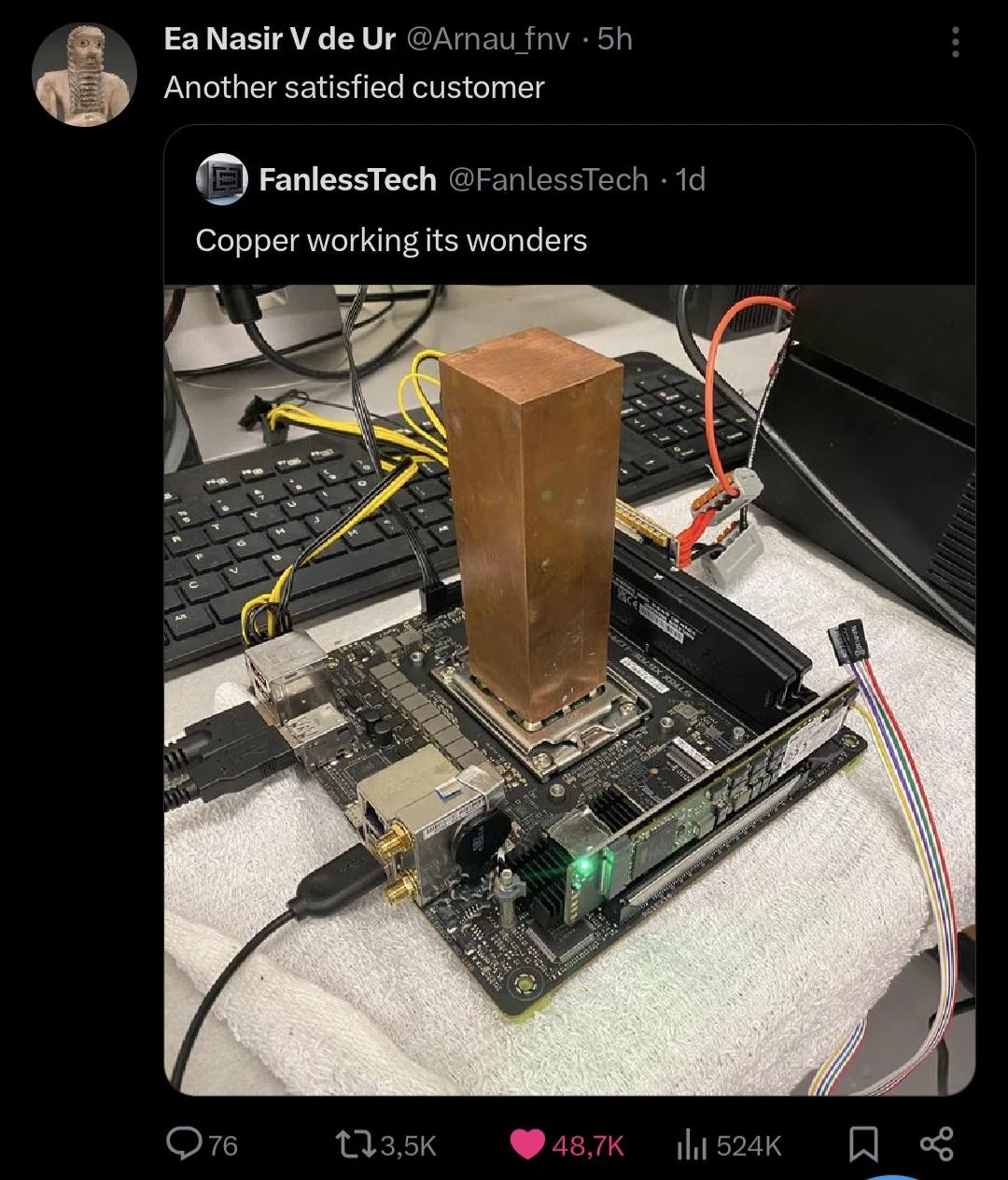
Heat transfer will not limit much, but heat loss should add a significant amount of time. How did you model that?
I left another comment going into more detail about the model specifications, if you’d like to read into it. But briefly: I took the copper heat conductivity coefficient and the air heat transfer coefficient. I sliced the copper block into thin slices and modeled heat transfer between each slice, as well as heat transfer between each slice and the surrounding air.
It seems that both heat transfer and heat loss do actually matter quite significantly, but they just cancel each other out almost entirely.
If we assume instantaneous heat transfer, thermal throttling time goes up from 592 seconds to 703 seconds (about 2 minute difference).
If we assume no heat loss to the air, thermal throttling time goes down from 592 seconds to 500 seconds (about 1.5 minute difference).
If they cancel out, the system would be in balance and not get hotter. So some thing does not add up. What heat transfer coefficient did you use and which other numbers etc.?
No, the heat propagation through the copper block (meaning the contact surface gets to 100 degrees before the top of the block) balances out that the copper block loses heat to the surrounding area via it’s side walls.