

Unomelon, the developer of Minecraft-inspired sandbox game Allumeria, says a DMCA from Microsoft, evidently related to Minecraft, got the game removed from Steam.
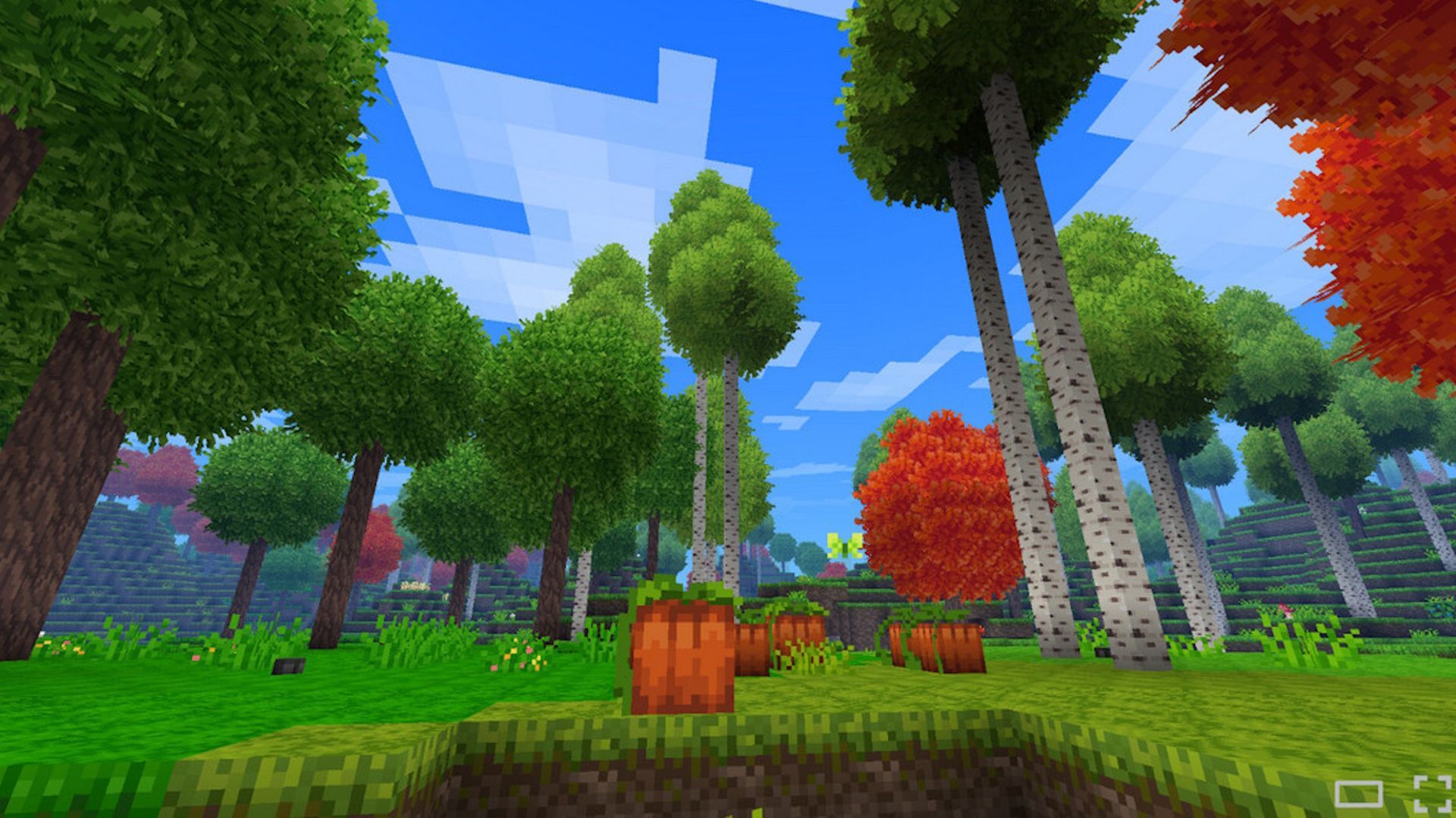
“The Allumeria Steam page is currently down because Microsoft has filed a false DMCA claim on it,” Unomelon said on Bluesky on Tuesday. “They sent an email earlier today claiming that this screenshot infringes on their copyright. I am taking a moment to figure out what my path is going forward, will update soon.”
The screenshot in question (above) is a simple wide shot of a forest filled with birch trees, what look to be oak trees with green and autumnal leaves, and a few pumpkins and weeds checkering the grassy dirt. There are definitely some similarities to Minecraft; if you told me this was a screenshot of a Minecraft mod, I’d probably believe you, but that’s true of many voxel-based games, including Hytale.
Is there a legal precedent on how copyright can be used against game clones?
I know that there is for board games, and there it says that the art and the rulebook cannot be identical, but that game rules aren’t protectable. So it’s basically the same level of protection that e.g. a painting would have.
If the same thing holds true for video games, then “The gameplay being similar” shouldn’t matter at all, and the only question is whether the art is too similar.
Considering that the art for voxel games is limited by technicalities (1m size blocks are required by the gameplay) and the low-resolution texture art style, I would naively guess that there’s not much room for differentiation and thus unless the textures are actual 1:1 copies of minecraft textures, there’s not much that can be done there either.
There aren’t a lot of ways you can draw a low-resolution square birch texture.
The gameplay being too similar is a bogus argument Microsoft’s AI probably snuck in there. I mentioned it to support my point that the DMCA complaint isn’t about the birch trees specifically, but that’s definitely not an argument that would have worked out legally for Microsoft.
Patents could work out, like for Nintendo in the Palworld case. But DMCA is a copyright dispute, patent law doesn’t apply here. And who knows if they even have any relevant patents to accuse this game of violating.
IANAL, and this is oversimplifying. Copyright protects the creative elements of a game, including the specific way that a game is coded (so you cannot decompile a game, modify all the art assets, change the code a little, and then sell it), and possibly aspects of the gameplay required to give it a specific “feel”.
If you want a solid legal defense for cloning, you could have one team that describes the original game in a way that removes the creative elements, and a second team that works from that description to make a new work. This works for other works, too; I can write my own “book about an orphan that learns he has magical powers, goes to a school to learn to use those, and ultimately battles and defeats the powerful dark wizard that killed his parents”, but can’t sit down following the story elements of Harry Potter for my new Barry Cotter book series.
Ultimately the line is what you can convince a judge and/or jury is “different enough”.
They aren’t? There’s nothing that requires a voxel to represent a 1m cube. They could be 0.5m cubes, or even something exotic like spheres with a calculated surface stretching over them to smooth out the result. 1m cubes are just convenient and popularized by Minecraft.
Yes, they are required by that type of gameplay. 0.5m cubes mean that mining and placing blocks takes 8x as long. That is a massive change in the gameplay.
Can you do a voxel game where mining and building is extremely fiddly and everything is much more laboursome than with 1m blocks? Sure you can. Has been done. And it sucks.
You could also do a voxel game where mining and building is not extremely fiddly and nothing is much more laboursome than with 1m blocks.
Terraria, Starbound and many other similar games manage to do it in 2D by making you mine more than one block at a time, what makes it impossible in 3D spaces?
Digging, if you don’t care about accuracy, can be done with smaller blocks.
Building not. Try building a nice house, but when you try to place blocks you get a burb of tiny blocks being strewn all over.
Look at what people are actually doing in Minecraft. Terraria is a completely different game, especially in regards to this mechanic and the gameplay surrounding this mechanic.
Also, for a 2D game, halving the block size means you quadruple the amount of blocks. For a 3D game it’s 8x.
2D and 3D are vastly different and stuff that works in 2D often doesn’t work in 3D or vice-versa.
For example, try to make a 2D first-person shooter. Or an RTS where units can freely move in 3D. Even something as simple as Chess completely falls apart when you introduce a 3D playing field.
(Goes without saying, this is about 2D/3D gameplay, not 2D/3D graphics. Every physical chess set has 3D graphics, but they also all have 2D gameplay.)
… so Vintage Story doesn’t exist, and neither does its axis-aligned voxel placement when chiseling?
You can still build things in it, I don’t see how that’s relevant to the topic of 1m blocks being a hard requirement.
You don’t need to divide voxels by powers of two, Terraria and Starbound have roughly 2x3 player hitboxes - which would translate to 2x3x2 hitboxes in 3D spaces.
Homeworld fans, back me up