- cross-posted to:
- technology@lemmy.ml
Everything I just read in that article confirms that moving to Linux (with OSX secondary) was the right choice.
Another area Microsoft focused on was improving the taskbar experience on smaller screens and touch devices.
This is Windows 8 and “metro” interface all over again. Its forcing users to bend to small devices touch screen users. Microsoft, look at your own history and see how well that worked out for you.
Brand identity.
Corporations, and even some open source groups, hate highly visible customisation; they behave as if your computer shouldn’t look like your computer, it should look like their software’s computer.
Of course, this conflicts with what users want. So sometimes they’re forced to provide you at least some highly visible customisation. More at the start, as they advertise their software as “flexible”, “powerful”, “customisable”, whatever. Then they remove it later, when they believe the loss of the customisation won’t make users leave.
But then people ask why. And they can’t simply say “it damages our brand identity”, or “you computer is not yours; it’s our billboard for our software, that you paid for”. And sometimes they can’t ignore the question either, because that would make them look distant and uncommunicative and user-hostile.
The solution is bullshit galore. You disguise the removal as necessary, telling users things like:
Sometimes they aren’t even lying that they redid it from the scratch, or that the feature wasn’t popular. The truth doesn’t matter here; that’s why it’s bullshit instead of a simple lie. The goal was always to get rid of that bit of customisation, and if you keep using their software without it, mission accomplished.
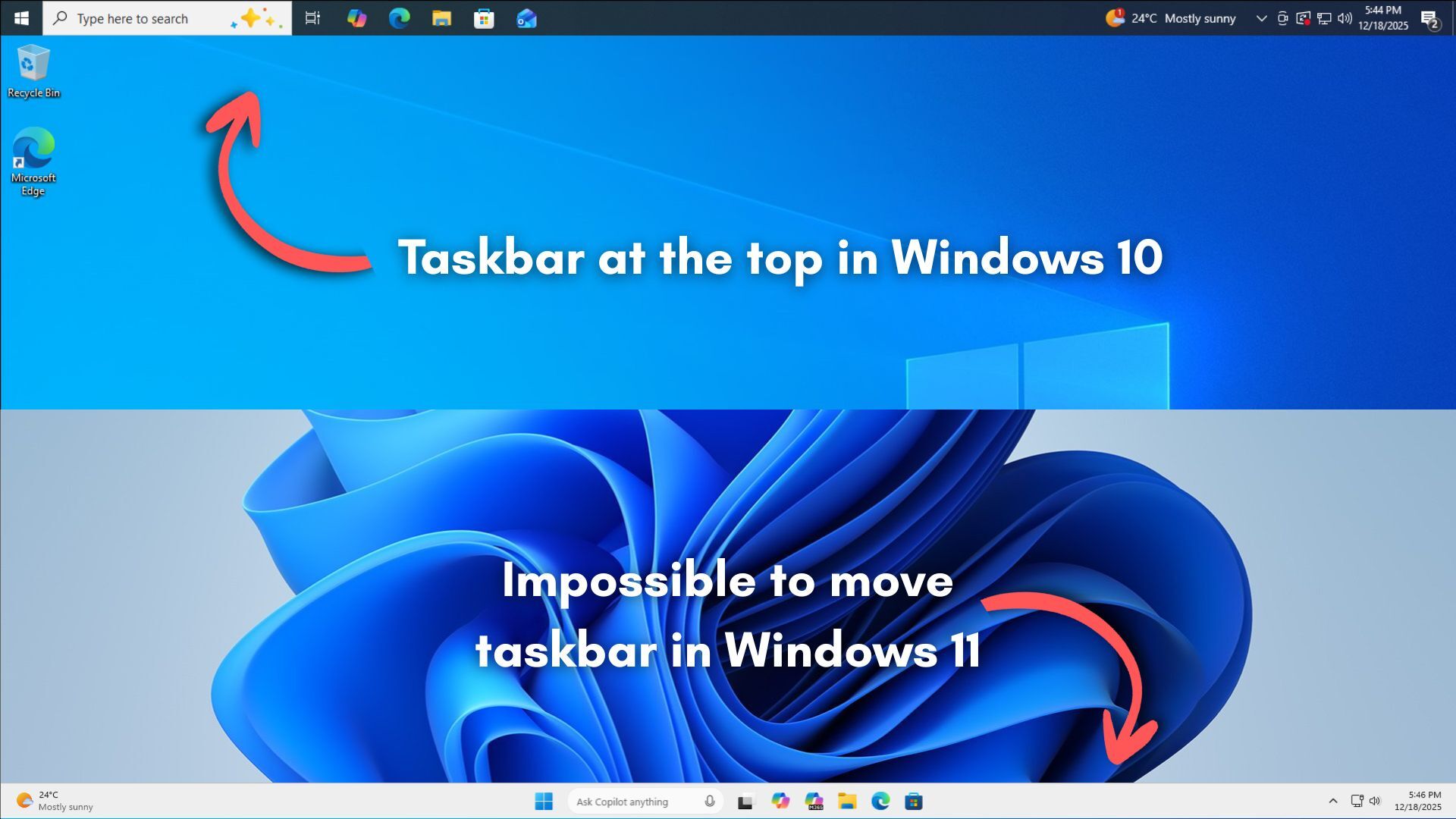
because Microsoft created the new taskbar from the ground up and didn’t use the old code from Windows 10.
Which excuses nothing. You CHOSE to dump and rewrite existing, functional code, before its replacement was fully realized. You intentionally degraded your product, based on the calculation that the portion of users who don’t care would be far greater than the portion who do.
And somehow just about every one of the hundreds of linux desktop environments you can choose from features a rock solid, fully customizable taskbar(s) which can be put wherever you want. Even in gnome which doesn’t allow you to move the taskbar by default, you can still move it with an extension and it doesn’t break anything.
Just one example, in XFCE you can put a taskbar of literally any size literally anywhere. Very useful if you have a broken corner of your screen, you can throw a taskbar there and windows will dodge it. You can even create a 1px wide taskbar right down the center of your monitor, splitting it into two spaces. All of this is completely seamless, behaves exactly how you would expect, and rock solid.
So WTF is microsoft doing exactly?
Because nobody understands how the ai coded the taskbar, including the vibe coder?
W11 was released in 2021, too early for ai. This was intentionally dropped in what appears to be removing user interference from their taskbar.
My takeaway from this is that Microsoft no longer has any core competency left in the primary area where they’re expected to have the highest level of core competency. Also really validates my decision to start moving to Linux rather than spending any more time on Windows.
This was deadass the thing that made me switch my daily driver to Linux. Moving the sidebar was so useful on multi-monitor setups.
The inability to move the taskbar to the top was literally one of my main reasons to switch to Linux. Good work, MS product manager.
Fuck it, I’m gonna vibe code an os as well.
Because it’s fucking trash.
Their marketing spin is such BS. Trying to say that the amount of rework needed for apps to provide a wonderful experience, etc. Those apps already have that “wonderful” experience in Windows 10, Microsoft just cut corners in a redesign and power users are rightfully pissed off.