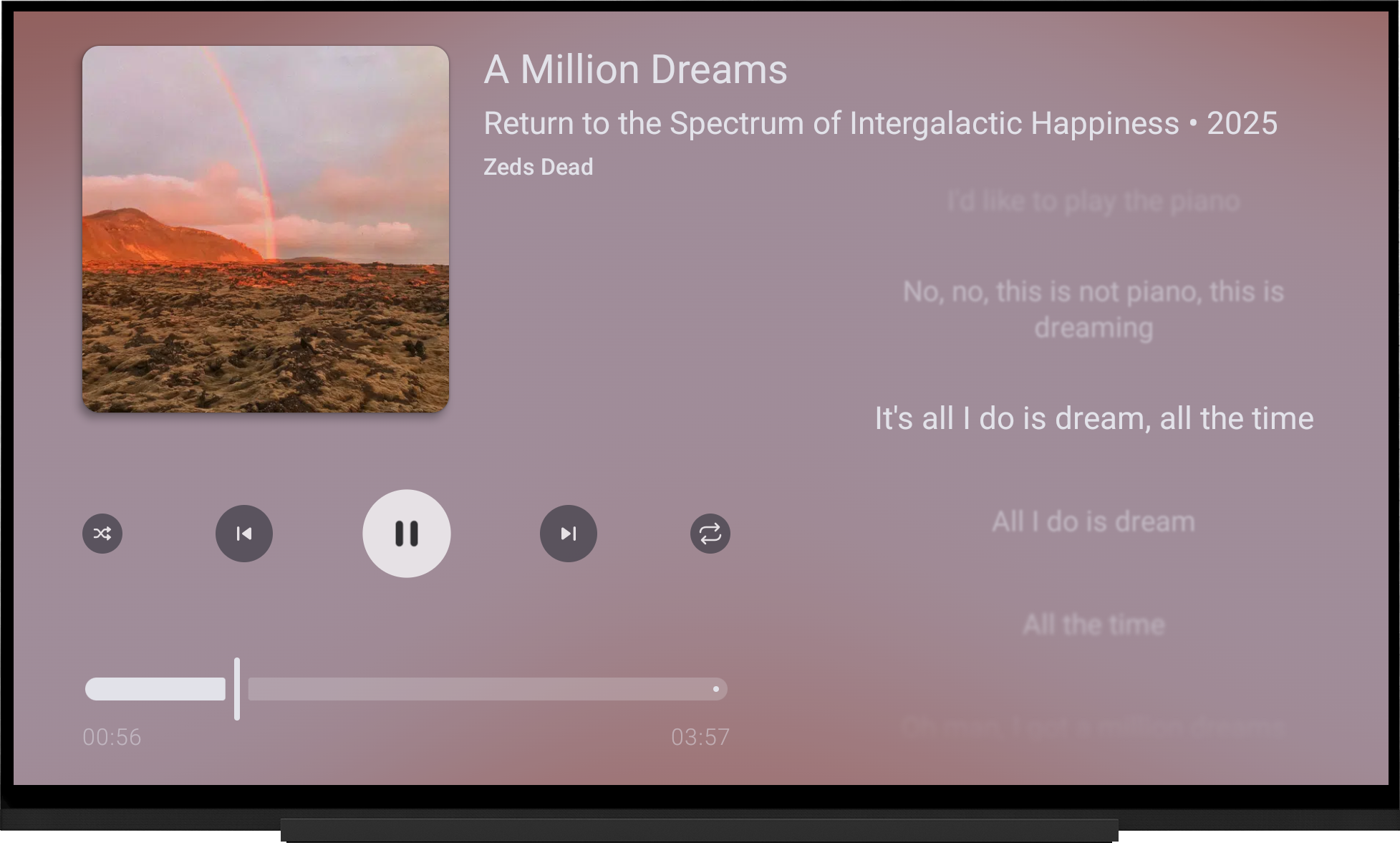

So if I understand correctly, you open the app or web on your phone, and it controls what’s playing on the TV via the server?


So if I understand correctly, you open the app or web on your phone, and it controls what’s playing on the TV via the server?


Symfonium is really great, but the TV version doesn’t quite work —or didn’t as of my testing probably a year ago.
I have also stopped using GMS, which makes using paid apps more difficult.
One thing that I really enjoyed was the Android Auto mode, which was flawless.


I’d be interested in hearing about your lyrion setup. I haven’t really tried it but it looks like that could open a whole software ecosystem. Do you use a phone app to select/skip/cue tracks?
It doesn’t necessarily have to be controlled by the TV remote, but it does need to be controlled away from the server.
Very interesting…
It’s traced back to about 8000 years, but not through records. Its history is reconstructed by linguists. So, it is often considered one of the oldest consistently used words, but I should not have called it the oldest “recorded word.”
Hint:
Far Side ≠ Dark Side
It can be confusing because the far side of the Moon is sometimes also referred to as the Dark Side because it is “dark” to us, in the sense that we cannot see it from Earth.
Fun fact, lox is possibly the oldest recorded word in continuous use with an unaltered meaning.
Smelling the wafffle without tasting it: “We know what the mass isn’t if that helps!”
Huh, I knew a lady like that once
Calibre Web Automated is a completely different project. I am liking it so far.
Some people have also suggested Kavita.


It’s a Russian project, which some people are suspicious of because Russia has leveraged open source projects for less-than-honest purposes in the past.
It’s managed by a for-profit company to sell their server software, which is generally approached with a big grain of salt in the FOSS community.
They preference OOXML files rather than ODF files by default, which some users (notably the document foundation) consider the more poorly-defined open standard, which benefits Microsoft (who mostly developed the OOXML format). This is some complicated inside baseball and the fork does not seem to be swayed by it—they’ll continue to preference OOXML.
OnlyOffice has contribution practices which are sometimes hostile to the FOSS ethos. The maintainers are not as transparent as most projects, they generally prefer to fix issues in-house rather than collaborate with a broader community on pull requests.
I still use it. Here’s why: I don’t think it’s very good ethics to be suspicious of an entire nationality; the code is open, so what are you afraid of? I guess it’s possible to sneak something malicious into a binary blob, but that borders on paranoia. I’ve personally found the team to be very responsive on issues that I’ve brought up in terms of function and design. When I have brought up issues with the function or design, they have been good partners and been clear in their actions. YMMV
FOSS only thrives because of public-private partnerships; I believe we should reward companies that offer open source code, even when they may not comply with some grand FOSS philosophy. I don’t like purity tests.
OOXML has, for better or worse, become the global document standard. Instead of lamenting it, we should be working to make it the best we can.
Basically, OnlyOffice works for me in a number of ways that LibreOffice doesn’t. I’m not interested in server-based document sharing, but I am interested in good design and mobile support. This fork is only focused on the server software, so I won’t be switching at this time.
For anyone who is not familiar already:
Calibre is a desktop application that has some file hosting/syncing features.
Calibre-Web is a server software that uses the Calibre library files, but can operate independently after setup.
Calibre Web Automated is a server software based on Calibre-Web with an overhauled UI and many additional features including automated ingest, OIDC, KOsync, file conversion and fixing, and more.


I don’t personally use it so I don’t know if it depends on davx5, but you can add a CalDAV calendar directly in Etar settings.
I think I was actually thinking of KashCal, which works with or without DAVx5 by design.
Okay, I found it. I was looking in the wrong place and going in circles instead of clicking through the documentation one screen at a time. How embarrassing!
You are 100% right that it is spelled out very clearly. Thank you for the patience.
Thanks for looking into it. What URL did you enter in the server endpoint? Is it just the HA domain? Or is it another link that I have to get from HA? I’m sorry if this is a dumb question but I genuinely don’t know.


Possibly underrated: CopyParty. Its an entire fileserver in a little over 1 MB. You can host it on anything that runs python and the client can be anything with a browser. It’s unbelievably simple and efficient. If I knew self hosting was this easy I would have started sooner.


For an unbelievably simple WebDAV server, you may want to look into copyparty.
It depends on your needs, as it is not as full featured as some options out there, but it’s one Python file that you can just download and open. Boom. Fileserver.


Same. It’s pretty much my best behaved container.
You are literally mad that a public service is serving the public.
Sources available on request.