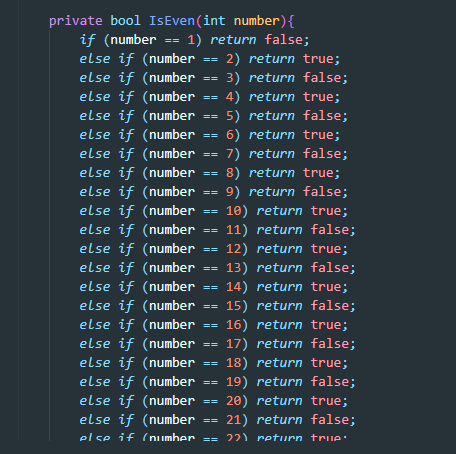
deleted by creator
def is_even(n): match n: case 1: return False case 0: return True # fix No1 case n < 0: return is_even(-1*n) case _: return is_even(n-2)Python added match/case?! Bunch of mypy issues have been closed too. Maybe its time to dust off some old projects.
It was added in 3.10 and is surprisingly complete. The tutorial pep is a good starting point to see what it can accomplish
You could do this in one line…
By removing all the linebreaks.
Of course there’s an easier way. Just integrate the state of the art API dedicated for this exact problem. https://isevenapi.xyz/
This is confusing. I’m already using the iSeven API to determine if a number is 7. I’m getting a namespace collision error when I try to load this new API. Bug report filed.
My solution in perl back in the day when I was a teenage hobbyist who didn’t know about the modulus operator: Divide by 2 and use regex to check for a decimal point.
if ($num / 2 =~ /\./) { return “odd” }
else { return “even” }Divide by 2 and check for a decimal point.
I mean, it ain’t wrong.
You know, I was going to let this slide under the notion that we’re just ignoring the limited precision of floating point numbers… But then I thought about it and it’s probably not right even if you were computing with real numbers! The decimal representation of real numbers isn’t unique, so this could tell me that “2 = 1.9999…” is odd. Maybe your string coercion is guaranteed to return the finite decimal representation, but I think that would be undecidable.
Ackchyually-- IEEE 754 guarantees any integer with absolute value less than 2^24 to be exactly representable as a single precision float. So, the “divide by 2, check for decimals” should be safe as long as the origin of the number being checked is somewhat reasonable.
Back when I was learning programming a lot of lessons would make you do something like this, and then show you the real way to do it in the next lesson. My reaction was always “why didn’t you lead with this?”.
You must see the pain before you confront it.
I know how to fix this!
bool IsEven(int number) { bool even = true; for (int i = 0; i < number; ++i) { if (even == true) { even = false; } else if (even == false) { even = true; } else { throw RuntimeException("Could not determine whether even is true or false."); } } if (even == true) { return even ? true : false; } else if (even == false) { return (!even) ? false : true; } else { throw RuntimeException("Could not determine whether even is true or false."); } }Have you tried seeing if the recursive approach runs faster?
I know an even better way. We can make it run in O(1) by using a lookup table. We only need to store 2^64 booleans in an array first.
modulo
pseudocode:
if number % 2 == 0
  return "number is even" (is_num_even = 1 or true)
else
  return "number is odd" (is_num_even = 0 or false)
plus you’d want an input validation beforehand
who needs modulo when you can get less characters out of
while (number > 1) {
  number -= 2;
}
return number;
very efficient
edit: or theres the trusty iseven api
here is somewhat less:
return (number % 2) == 0;return !(number & 1);This is the way. Modulo takes too long to compute, bitwise compare should be a lot faster.
return !(number & 0x1);oh shit yo
this comment chain is pretty awesome, I learned a lot from this thanks!
#You are an input. You have value! You matter!
if number % 2 == 0
  return "number is even" (is_num_even = 1 or true)
else
  return "number is odd" (is_num_even = 0 or false)
Am I doing it right? /S.
Don’t put nbsps in code blocks, they show up literally.