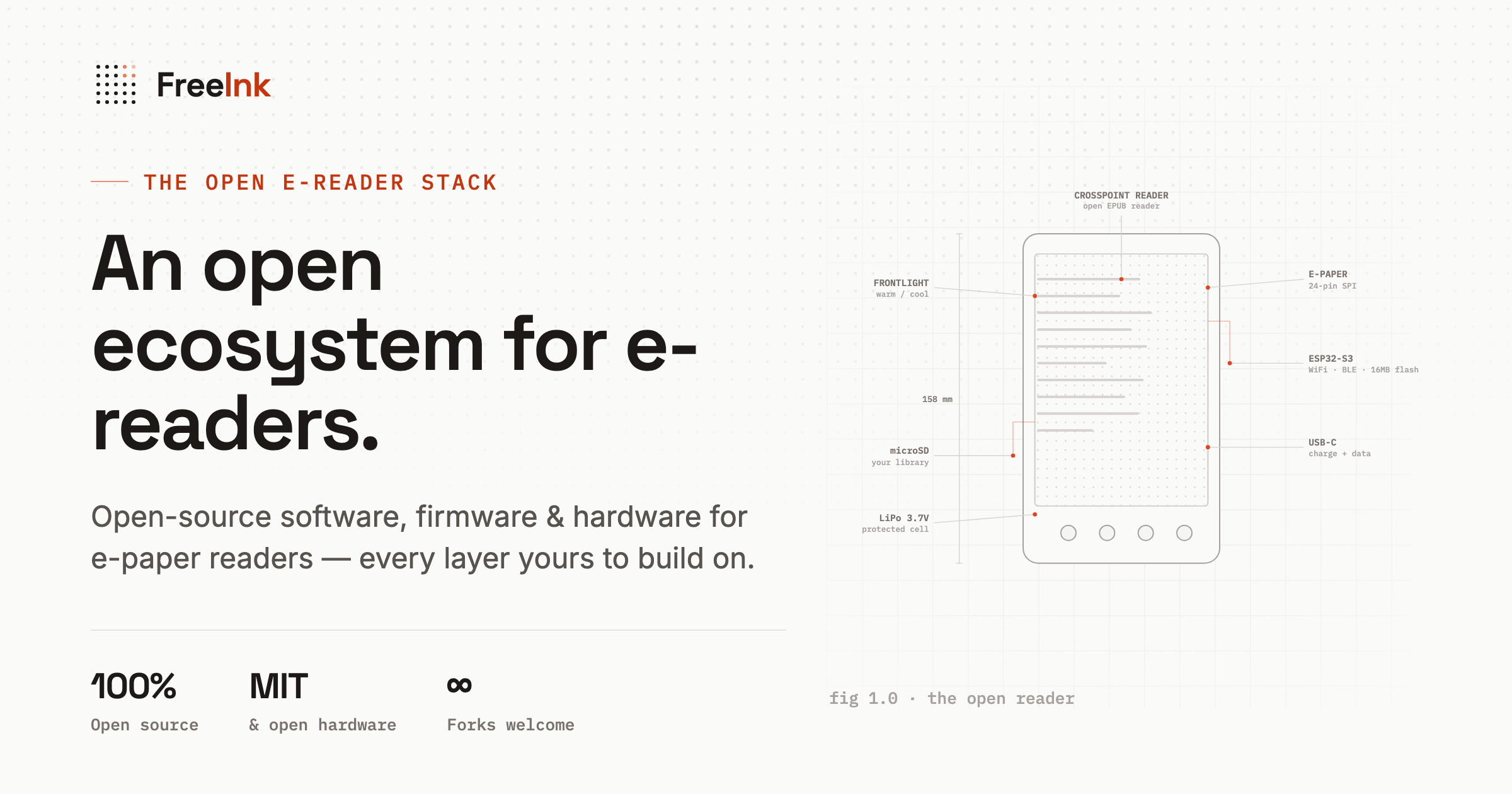
Free Ink is an open-source collective building the software, firmware and hardware for e-paper readers — every layer ships in the open for anyone to pick up, extend and make their own.
It is really all you need for a basic e-reader. However, I am not convinced that it will survive feature creep.
Esp32 runs out of headroom extremely quickly once audio processing (TTS) and screen annotation/highlighting are involved. Especially if they are implementing high quality partial refreshing.
I hope they can stick to the basics and make it a great, polished software experience because that is probably be the difference between failure and success of it, not featute-packing.
I can see that being a concern for Amazon where they need to convince people to buy a new Kindle every year or two. Hopefully it’s less of an issue here.

It is really all you need for a basic e-reader. However, I am not convinced that it will survive feature creep.
Esp32 runs out of headroom extremely quickly once audio processing (TTS) and screen annotation/highlighting are involved. Especially if they are implementing high quality partial refreshing.
I hope they can stick to the basics and make it a great, polished software experience because that is probably be the difference between failure and success of it, not featute-packing.
Maybe I’m the weird one, but I’ve never used any of those features (TTS, highlight, etc) on my Kindle.
No I think that is normal, but trying to cover all edge cases and accessibility are quite common reasons for feature creep.
I can see that being a concern for Amazon where they need to convince people to buy a new Kindle every year or two. Hopefully it’s less of an issue here.