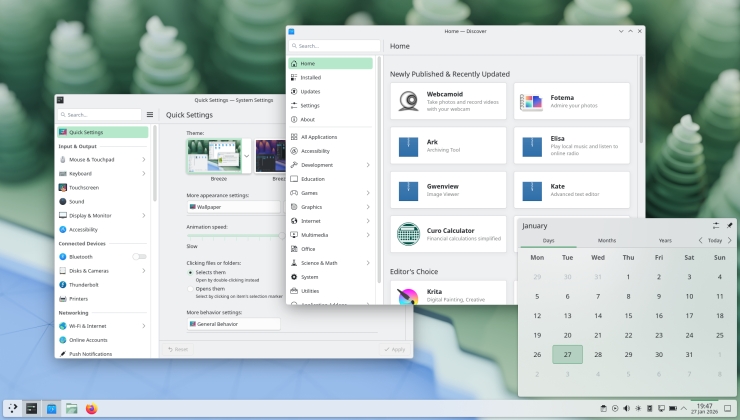
Germany's Sovereign Tech Agency via the Sovereign Tech Fund announced over €1 million in funding for KDE to work on the Plasma desktop, KDE Linux and more.
I love KDE, but as someone who exclusively uses KDE already I have little visibility into Gnome or any other alternatives really, and I’m a little surprised they aren’t defaulting to Gnome since that seems to be the default choice for many distros. Besides my personal feelings that it’s a bit ugly and very clunky to configure, anyone feel like ranting about the drawbacks of Gnome or other desktop environments so that I can feel educated and continue to justify their and my choice of KDE to myself? :)
Nothing wrong with Gnome, it’s very good in my book. It’s simple so you can recommend it to a non-tech friend (who does not expect things to look like Windows). Yet it’s powerful enough so you can use it as a power user quite efficiently. KDE is just much more options, if you need them. Not everyone needs, so I think both are welcome to advance and be actively developed.
KDE was always niche before, but my understanding is that Plasma5 is all the rage now, and more distros are defaulting to Plasma.
As someone who still remembers when Plasma4 was announced it feels really nice to see just how little KDE has changed over the past two decades - all changes are pretty much optimizations and stability fixes. Goes to show how well-thought-out the vision for Plasma was from the start.
Right, I’m living in the past. Still though, Plasma6 just feels like a polished continuation of what Plasma has been all along. And that’s a good thing. When Plasma7 comes out in 12 years I expect it to be the same.
Plasma 7 is being renamed Desktop For Plasma365 2027 edition.
Everything is electron apps. Native apps are ran as web assembly inside an electron app.
There will be no UI, only a shitty AI chatbox that is always suggesting results from askjeeves (and takes 5 seconds before it suggests anything from your local machine).
Oh, and it’s a monthly licence now.
And it’s actually just a laggy local UI of the actual desktop that is ran in the cloud on a container with 512mb ram and 1 CPU.
Oh wait, this isn’t microslop.
Good things on Linux (generally) stay the same or get better, not different so “line goes up”.
I think I’m still getting over the windows PTSD
I’m expecting a fully streamed experience - compute offloaded to datacenters, beamed to your device via a swarm of satellites that block out the night sky, with an emphasis on a voice controlled user interface.
I’m in the same boat, I think Gnome being the default in some distros is mostly because of historical reasons, perhaps similar to how Ubuntu used be good


I love KDE, but as someone who exclusively uses KDE already I have little visibility into Gnome or any other alternatives really, and I’m a little surprised they aren’t defaulting to Gnome since that seems to be the default choice for many distros. Besides my personal feelings that it’s a bit ugly and very clunky to configure, anyone feel like ranting about the drawbacks of Gnome or other desktop environments so that I can feel educated and continue to justify their and my choice of KDE to myself? :)
Iirc, gnome also got a million from the Sovereign Tech Fund a while back (I think it was them + that amount of money, don’t quote me on this).
Imo: both are good and deserve it. They sometimes have different ways of thinking and goals, but both are usible for everyone - even for non-techies.
While I’m a gnome fanboy, it’s really cool to see financial support for good desktops!
Nothing wrong with Gnome, it’s very good in my book. It’s simple so you can recommend it to a non-tech friend (who does not expect things to look like Windows). Yet it’s powerful enough so you can use it as a power user quite efficiently. KDE is just much more options, if you need them. Not everyone needs, so I think both are welcome to advance and be actively developed.
KDE was always niche before, but my understanding is that Plasma5 is all the rage now, and more distros are defaulting to Plasma.
As someone who still remembers when Plasma4 was announced it feels really nice to see just how little KDE has changed over the past two decades - all changes are pretty much optimizations and stability fixes. Goes to show how well-thought-out the vision for Plasma was from the start.
Plasma 6 just came out, and it contains a whole lot of new UI and features. It’s much more than just security fixes.
Right, I’m living in the past. Still though, Plasma6 just feels like a polished continuation of what Plasma has been all along. And that’s a good thing. When Plasma7 comes out in 12 years I expect it to be the same.
Plasma 7 is being renamed Desktop For Plasma365 2027 edition.
Everything is electron apps. Native apps are ran as web assembly inside an electron app.
There will be no UI, only a shitty AI chatbox that is always suggesting results from askjeeves (and takes 5 seconds before it suggests anything from your local machine).
Oh, and it’s a monthly licence now.
And it’s actually just a laggy local UI of the actual desktop that is ran in the cloud on a container with 512mb ram and 1 CPU.
Oh wait, this isn’t microslop.
Good things on Linux (generally) stay the same or get better, not different so “line goes up”.
I think I’m still getting over the windows PTSD
I’m expecting a fully streamed experience - compute offloaded to datacenters, beamed to your device via a swarm of satellites that block out the night sky, with an emphasis on a voice controlled user interface.
I don’t use gnome or KDE, I use i3 or sway and then I install a file manager and then I use drun or a drun like program to launch applications
no kde bloat, no gnome bloat, a desktop with a status bar (no desktop icons) and that’s it
I’m in the same boat, I think Gnome being the default in some distros is mostly because of historical reasons, perhaps similar to how Ubuntu used be good