

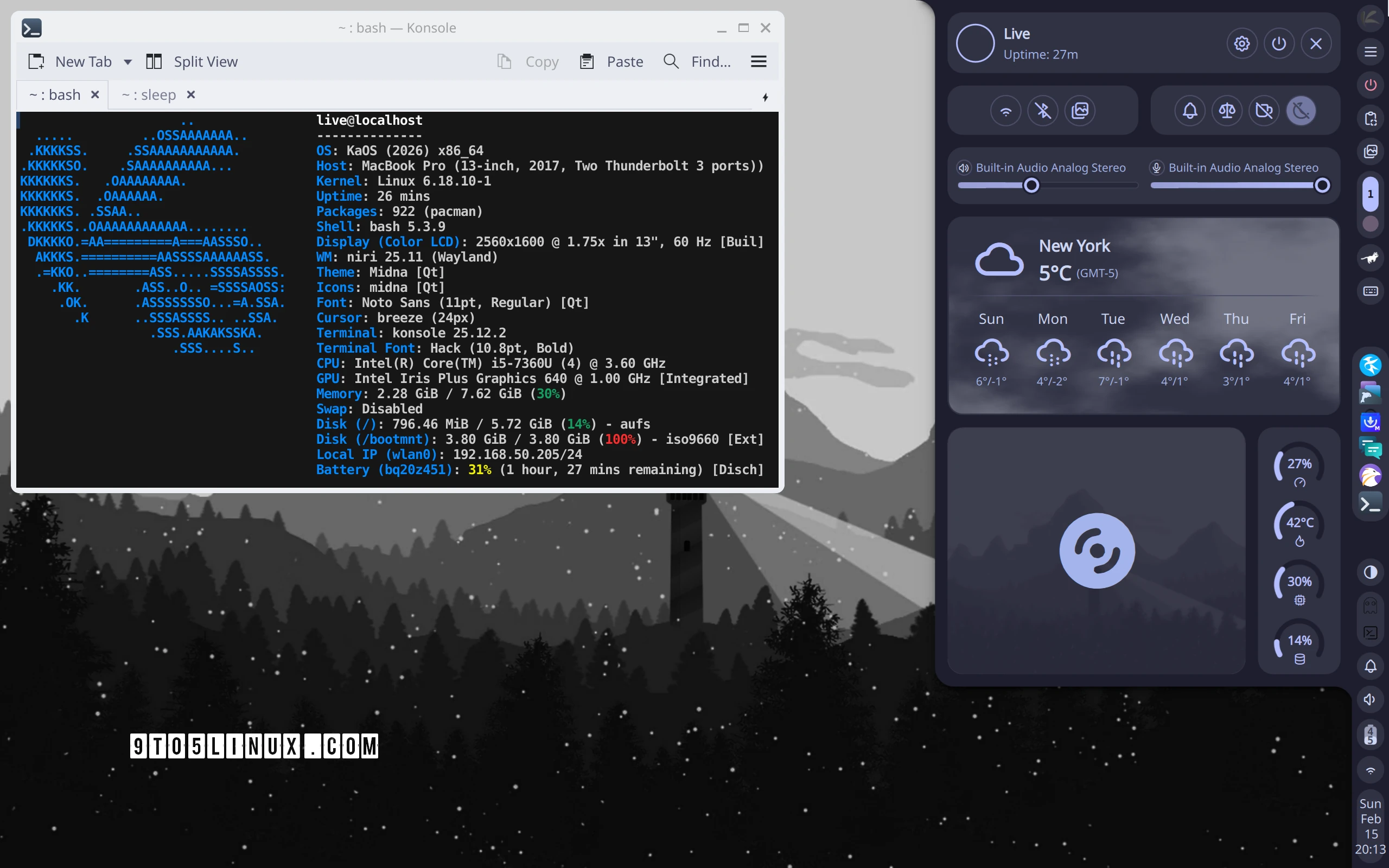
KaOS Linux 2026.02 was released today as the February 2026 ISO snapshot for this independent GNU/Linux distribution, which uses Arch Linux’s pacman package manager, and the first release to ship with the Niri Wayland compositor.
After using the KDE/Plasma desktop environment by default for more than 12 years since its initial release under the name of KdeOS, the KaOS Linux distribution will no longer ship with its unique Plasma desktop setup, as the devs do not want to use the systemd init system anymore in the distro.
Instead, they put a Niri/Noctalia setup into the KaOS Linux 2026.02 release, while retaining the distribution’s unique look and still offering users access to popular KDE applications that were shipped with the Plasma desktop. However, this release still ships with systemd as the default init system.
Are these “other features” hard dependent on systemd? If yes, how are they modular (or portable)? “My program can be used on any system with a couple of small dependencies: Linux kernel, glibc, and the systemd Kernel” /j
There are some attempts to use systemd tools independent for it, like elogind and eudev, but see what I mean. Hard forks (with major rewrites) are required because these tools heavily depend on systemd, which fine I understand having dependency, but you cant just use part of systemd since it is to tangled together. It would be nice if mire of systemd code was available as separate libraries so you could further reduce attack surface by building a significantly slimmed version of systemd+feature. I am unsure if you meant modular as in “you can choose to enable them” or as in “you can build without them” or both.
Also, I never claimed systemd ran everything under pid1, just plenty more then the should be, like init plus service manager (and more), not every single systemd tool because that would be beyond stupid and systemd isnt made by idiots.
That’s 2 different things. Gnome is hard dependent on systemd (or will be, I don’t follow its development that closely), but not part of it. This was big news last year: https://blogs.gnome.org/adrianvovk/2025/06/10/gnome-systemd-dependencies/
That’s what I write about at the end. And I think this is not good.
You can disable modules of systemd, if you want to use alternatives. E.g. systemd-resolved is part of systemd, but usually disabled by default (at least on Arch), and you can use different dns resolvers if you want, like resolvconf from freebsd, or the linux kernel has built in functionality for this as well. https://www.man7.org/linux/man-pages/man5/resolv.conf.5.html
This is a module of systemd, installed with it, but you can disable it and use alternatives. A lot other parts work this way in systemd.