
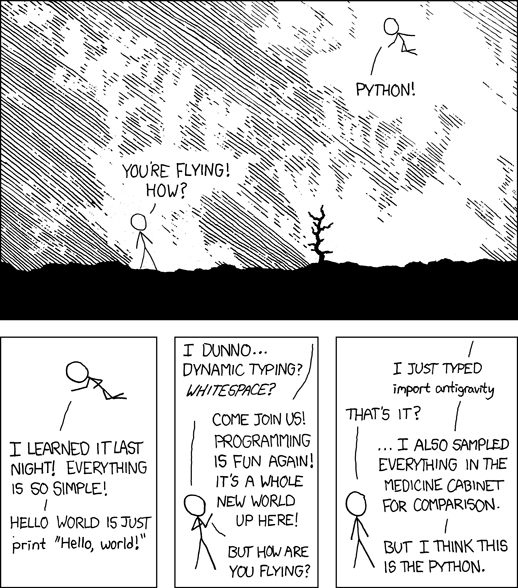
“Programming is fun again”
C was “fun” once. Hell, C is becoming so obscure, it’s fun again!
If anyone has some insight: is Rust more or less verbose than C, generally? Like if Linux would be rewritten in Rust, would the LOC increase or decrease, e.g.?
Rust has a lot more ‘batteries included’ than C, and the memory ownership model works a lot better than garbage collection or C’s YOLO model. It also has built-in async/await. But you’re pretty much in the same boat as C when it comes to multiprocessing or thread-safety.
Anyone building a long-running backend service would be wise to take a serious look at Rust. Personally, I’m glad Linus is open to change and isn’t digging his heels in on this one.
I agree with you on Linus. Very pragmatic here, and for the benefit of all in the case of Rust in the kernel.
And thanks for sharing your insight!
It’s easier than C, it’s safer than C, the compiler is more helpful than GCC
I think it’s fun
Less verbose? I don’t think so
Lines of code about the same
For someone starting out as a programmer for low level programming I would recommend rust
For the same purpose, would you recommend Rust over Zig?
As someone who has used both (but not for any serious, large projects), I’d say they target different audiences. First and foremost, Zig is not memory-safe in the way Rust is. On the other hand, Zig is way easier to write than
unsafeRust. Rust comes with a lot of features and libraries, while Zig is an intentionally small language, almost minimalistic (kind of like C, but modern).There are lots of different tradeoffs being made, so yes, I’ll give the boring answer and say they are good for different kinds of projects :)
If it’s specifically low level programming (I’m envisioning programs where you need fairly direct control over memory, IO, etc.), you’d probably quickly need a lot of
unsafein Rust, which can quickly get very complicated to use safely. So I’d probably recommend Zig for that purpose.I should’ve known it’s a “it depends” answer. 😆 It’s programming languages after all. 😉
Thanks for the insight though, I appreciate it! 🙏
I know nothing about Zig
Alright, thank you.
I think at the lowest level, it is very similar.
But with a bit more abstraction, Rust is somewhat less verbose, especially when the same efficiency is required. Thinking im iterators / loops or generics, or enumerations / sum types. Also, the module system, build system, integrated unit tests, and compiler messages are huge gains for productivity.
Cool, thank you. Might tackle Rust next year then.
This year I’m getting into OCaml. 😊
OCaml should transfer pretty well to Rust. Rust can feel like an ML dressed up in C’s braces.
Similarly, if you can write in Haskell without having to reach for
IO, then you can probably satisfy Rust’s borrow checker with no more effort.Thanks for that insight. I did some small delving into Haskell years ago, but I found the tooling to be so awkward, and “monads” so confusing and poorly explained everywhere, that I eventually gave up trying to learn more.
But OCaml seems pretty nice. Familiar, but with hopefully better tooling. 🤞
Fun because you like rewriting existing code?
Fun because you already have test suites you don’t have to rewrite?
Fun because you feel morally superior by writing fresh code, even though the old code is running critical applications in production?
Fun because you think your smarter than the engineers that lay the ground work before you?
Fun because you like hunting bugs you created thinking you know better, while calling your rewrite superior.